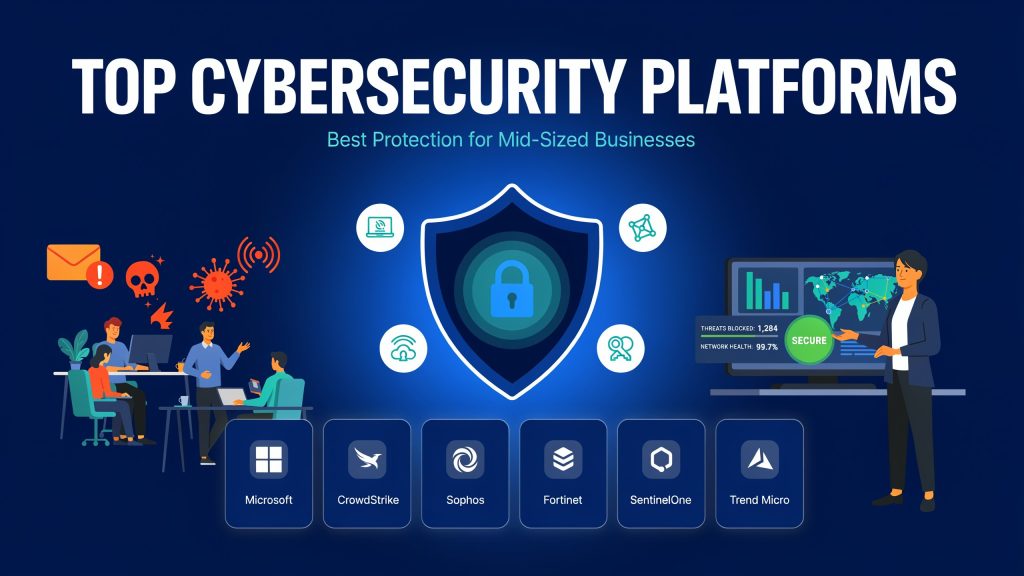
Mid-sized companies (roughly 100–1,000 employees or 200–500 endpoints) sit in a difficult spot. They are large enough to attract sophisticated attackers yet rarely large enough to staff a full 24/7 security operations center. In 2026 the market has moved past pure endpoint protection. The platforms that matter combine extended detection and response (XDR) across endpoints, identity, email, and cloud, AI-assisted triage that reduces alert volume, and practical managed detection and response (MDR) options for teams that cannot watch the console overnight.
Choosing wrong still produces one of two outcomes: either a flood of alerts that a two- or three-person team ignores, or an expensive platform whose advanced modules sit unused. This guide focuses on the options that actually fit mid-market constraints—existing Microsoft 365 or hybrid environments, limited internal headcount, and the need for manageable total cost and operational load. It maps the leading platforms to those realities rather than feature checklists.
What Mid-Sized Companies Actually Need in 2026
A mid-sized security program in 2026 prioritizes operational fit over maximum feature density. The requirements that repeatedly separate successful deployments from shelfware are concrete:
- Coverage that spans endpoints, identity, email, and key cloud workloads rather than endpoint alone. Identity and MFA failures remain the most common initial access vectors.
- AI or automated triage that meaningfully reduces the volume of alerts a small team must review. Pure per-endpoint platforms that still require manual investigation create alert fatigue that pure feature lists do not capture.
- A practical path to MDR or co-managed services when continuous monitoring is unrealistic in-house. Most mid-market teams cannot staff nights and weekends.
- Tight integration with the identity and productivity stack already in place (especially Microsoft 365 or Google Workspace). Starting from a clean sheet is rarely feasible.
- Manageable total cost of ownership that includes license, operational effort, and any managed service—not just the published per-endpoint number. Module creep and under-used advanced tiers are common cost drivers.
- Clear response capabilities (isolation, rollback where relevant, automated containment) that work without requiring a dedicated SOC analyst for every incident.
Identity protection is non-negotiable. Endpoint-only tools leave the most common entry points under-protected. Cloud and email signals improve detection of multi-stage attacks, but only if the platform can actually correlate them without forcing the team to maintain a separate SIEM for basic use cases.
Platform Categories That Matter
Mid-market buyers in 2026 effectively choose among a few practical categories rather than a single “best XDR”:
- Endpoint-led XDR platforms (CrowdStrike Falcon, SentinelOne Singularity) that deliver strong independent detection and response and can be extended toward identity or SIEM. These work across mixed operating systems and non-Microsoft identity environments.
- Microsoft-native stacks (Defender for Endpoint / Defender XDR, often with Security Copilot). These deliver the highest ROI when Microsoft 365 E5, Business Premium, or equivalent licensing is already in place, because much of the stack is already paid for.
- Network- and fabric-centric suites (Palo Alto Cortex XDR, Fortinet Security Fabric / FortiEndpoint). These make sense when the organization has already standardized on that vendor’s firewalls or network security and wants to extend the same operational model to endpoints.
- SIEM + XDR bundles (Rapid7 InsightIDR / Incident Command and similar). These suit teams that want detection, investigation, and some response in one bill instead of stitching a separate SIEM to an EDR agent.
- MDR or AI SOC overlays. These are either native managed services from the platforms above or specialized overlays. They become the practical choice when the internal team cannot staff continuous monitoring, regardless of which underlying platform is chosen.
The decision is rarely “which platform has the best detection score.” It is which combination of platform and operating model the existing team can actually run without creating more noise or unused licenses.
The Leading Platforms
CrowdStrike Falcon
Best for: Mixed environments that want strong independent detection, threat intelligence, and a clear path to MDR without being locked into a single productivity suite.
Strengths: Falcon Enterprise (published list around $185 per device per year on annual billing as of late 2026) includes EDR/XDR capabilities and managed threat hunting (OverWatch). The platform has a strong independent testing record and deep adversary intelligence. Falcon Complete provides a mature 24/7 MDR option (priced by quote). A single lightweight agent reduces performance overhead, and the platform extends cleanly into identity and cloud modules for organizations that want to consolidate later. Self-serve entry tiers exist for smaller fleets, though full EDR begins at the Enterprise tier. Go is limited to 100 devices and does not include EDR.
Limitations: Full platform cost rises quickly once identity, SIEM, or additional modules are added; many mid-market teams that start near the Enterprise list price later land higher through incremental purchases. Alert volume still requires ownership or an MDR overlay for lean teams. The 2024 global outage remains a reference point for update risk, even if subsequent process changes have reduced recurrence. Identity protection and Next-Gen SIEM are not included in the published Enterprise bundle.
Pricing character: Transparent per-device list prices for the self-serve tiers; Enterprise is the practical floor for real EDR. MDR and advanced modules are quote-only. Monthly billing carries a significant premium. Negotiated discounts of 15–30% are common once volume or multi-year terms are involved, but the license is only part of the cost—the operational load of triaging alerts is often larger for a small team.
When to choose it: You run a mixed OS environment or non-Microsoft identity, value independent threat intelligence and hunting depth, and either have (or will add) the capacity to operate the console or budget for Falcon Complete. It is less compelling purely on cost if you already hold Microsoft 365 E5 licensing.
SentinelOne Singularity
Best for: Mid-market teams that prioritize autonomous response, ransomware rollback, and competitive value against CrowdStrike.
Strengths: Singularity Complete publishes at approximately $180 per endpoint per year (for the 5–100 workstation band) and includes EDR with autonomous prevention, detection, and response plus an AI assistant. One-click ransomware rollback (particularly effective on Windows) and strong on-agent behavioral AI that continues to function offline are practical differentiators. Commercial tier (~$230) adds identity threat detection and longer retention. The platform is frequently cited for reducing manual response work on common ransomware and commodity threats. Partner/MSP channels are mature, which matters for many mid-market buyers.
Limitations: Purchases typically route through partners rather than direct self-serve for most organizations, so final pricing and packaging depend on the partner. Default data retention on Complete is relatively short (14 days) before upgrades. Independent testing participation has been less consistent in some recent cycles than CrowdStrike’s. MDR (Wayfinder and related services) is an add-on with unpublished list pricing. Rollback is most reliable on Windows.
Pricing character: Published per-endpoint prices that are competitive with CrowdStrike at the EDR tier. Higher tiers and managed services move to quote. Partner discounting is the main commercial lever. Total cost still depends on whether the team can operate the autonomy features without additional managed support.
When to choose it: You want strong autonomous response and ransomware recovery capabilities, prefer slightly lower published EDR pricing than CrowdStrike Enterprise, and are comfortable buying through a partner or MSP. It is a frequent shortlist peer to CrowdStrike for mixed environments where Microsoft-native is not the default.
Microsoft Defender XDR (with Defender for Endpoint)
Best for: Companies already deep in Microsoft 365, where much of the capability is already licensed.
Strengths: Defender for Endpoint Plan 2 (and related capabilities) is included in Microsoft 365 E5 and available via Business Premium or standalone for smaller mid-market. Defender XDR correlates signals across endpoint, identity (Entra ID), email, and Microsoft cloud workloads. Automated investigation and response, attack disruption features, and Security Copilot (now more broadly available in E5 environments) reduce analyst time on common alerts. Deployment is often simpler when Intune and Entra ID are already in use. Mid-market reviewers frequently cite operational efficiency and lower incremental cost as the primary advantages. IDC and other assessments in 2026 continue to position Microsoft as a leader in modern endpoint security, particularly for integrated environments.
Limitations: Correlation and advanced XDR capabilities are strongest within the Microsoft stack; non-Microsoft endpoints, identity systems, or third-party cloud platforms receive less native benefit. Plan differences matter—lower tiers have more limited response actions. Full value still requires configuration, tuning of automated responses, and often Security Copilot or equivalent for AI-assisted triage. Teams that expect pure “set and forget” without any ownership still face residual alerts.
Pricing character: Incremental cost is frequently the lowest of the major options when E5 or Business Premium is already held. Standalone Defender for Business or Plan 2 pricing is per-user and substantially below pure per-endpoint independent platforms for Microsoft-centric fleets. The economic case weakens quickly outside a Microsoft-heavy environment.
When to choose it: You are already on Microsoft 365 E5, Business Premium, or equivalent and want the highest ROI without adding another agent and console. Start here for most Microsoft-centric mid-market organizations; evaluate CrowdStrike or SentinelOne only if specific detection gaps, mixed-OS requirements, or dissatisfaction with alert quality appear in a pilot.
Palo Alto Networks Cortex XDR
Best for: Teams that already run Palo Alto firewalls or are open to a broader platform investment and want consolidated analytics across endpoint, network, and cloud.
Strengths: Cortex XDR has long been positioned as a true XDR platform that correlates endpoint, network, and cloud telemetry with strong behavioral analytics. In 2026 releases (including Cortex XDR 6.0 and XDR One), Palo Alto added deeper coverage for AI agents and agentic tools on endpoints, plus continued improvements in automated investigation. Independent test results remain strong, and the platform benefits from tight integration with Palo Alto’s network security stack. Unit 42 threat intelligence and optional managed services provide a path for teams that need more than self-managed detection. Organizations that standardize on Palo Alto often report cleaner operational workflows than stitching multiple vendors.
Limitations: It is typically a larger platform commitment than pure endpoint XDR. Pricing is quote-based rather than published per-device list prices, so mid-market teams must negotiate carefully. Full value often depends on deploying or already owning complementary Palo Alto components; pure endpoint-only deployments can feel heavier than CrowdStrike or SentinelOne for the same use case. Operational complexity rises if the team does not already have Palo Alto experience.
Pricing character: Quote-only. Total cost depends heavily on the modules selected (endpoint, network, cloud, AI agent security) and any managed services. Competitive for organizations already invested in Palo Alto infrastructure; less attractive as a pure endpoint replacement when Microsoft 365 or an independent EDR is already in place.
When to choose it: You already run Palo Alto firewalls or plan a network-plus-endpoint consolidation, and you want analytics depth plus emerging AI agent controls. It is usually not the first choice for a Microsoft-centric mid-market team looking only for endpoint and identity coverage.
Sophos (Intercept X + MDR options)
Best for: Mid-market firms that want synchronized security across endpoint, firewall, and email with strong managed service availability.
Strengths: Sophos has long targeted the mid-market with Intercept X for endpoint protection and a mature MDR offering. The platform synchronizes signals across endpoint, Sophos Firewall, and email security, which reduces the integration work a small team must perform. Sophos was named a Leader in the 2026 IDC MarketScape for Worldwide Managed Detection and Response Services for Midmarket. MDR includes threat hunting and flexible engagement models (guided or fully managed response). Since late 2025, Sophos MDR and XDR subscriptions have included broader third-party integrations at no extra cost. Recent additions such as M365 backup partnerships further support recovery use cases. The platform is frequently deployed through MSPs, which fits many mid-sized companies.
Limitations: Pure self-managed XDR depth and independent testing visibility are generally viewed as secondary to CrowdStrike or SentinelOne. Organizations that do not use Sophos firewalls or email lose some of the “synchronized security” advantage. Advanced AI features and full platform value still require configuration and ongoing ownership if MDR is not added.
Pricing character: Quote-based, typically sold through partners or as part of MDR packages. Mid-market pricing is often competitive when MDR is included, because the managed service absorbs much of the operational load. Standalone endpoint pricing is less differentiated than the managed offering.
When to choose it: You want a practical mid-market stack with strong MDR availability and prefer a single vendor (or MSP) for endpoint, firewall, and email. It is a frequent choice for companies that cannot staff 24/7 monitoring and value co-managed or fully managed response.
Rapid7 InsightIDR (Incident Command)
Best for: Mid-market teams that want one platform combining SIEM, detection, and some XDR/response capabilities instead of stitching separate SIEM and EDR tools.
Strengths: InsightIDR (now often referred to under the Incident Command branding) delivers a cloud SIEM with user behavior analytics, threat intelligence, and endpoint detection capabilities in higher tiers. It is designed for teams that need investigation context across logs, endpoints, and identity without building a full enterprise SIEM. AI-assisted triage is available in advanced packages. The platform has historically been positioned as more accessible for mid-market security teams than traditional SIEM tools. Managed Threat Complete provides an MDR upsell path. Asset-based pricing can be more predictable than pure ingestion-based SIEM models for organizations that control their data sources.
Limitations: Full XDR and advanced response features sit in higher tiers. Pricing is largely quote-only with minimums (historically around the 250-asset range for certain packages). It is not a pure endpoint platform—teams still need solid endpoint agents, and the SIEM component requires ongoing tuning of data sources and detections. Organizations that already have a mature SIEM may find the incremental value smaller.
Pricing character: Primarily quote-only, asset-based annual subscriptions. List references in 2026 for lower tiers start in the range of roughly $70+ per asset per year, with higher tiers and MDR moving higher. Minimum commitments apply. Competitive when the goal is consolidating SIEM + detection rather than buying a best-of-breed EDR alone.
When to choose it: You want SIEM-style investigation and detection in one bill and do not already run a separate SIEM. It fits mid-market teams (roughly 250–5,000 assets) that prefer a single platform over separate EDR and log management tools. Less ideal if you already have strong Microsoft Sentinel or CrowdStrike Next-Gen SIEM plans.
Fortinet Security Fabric (FortiEndpoint / FortiEDR)
Best for: Organizations where FortiGate firewalls are already central and the company wants to extend that fabric to endpoints.
Strengths: Fortinet’s approach emphasizes a unified agent and Security Fabric integration so endpoint telemetry can inform network policy and response actions. FortiEndpoint combines EPP/EDR capabilities with ZTNA, and recent updates have added AI visibility and control features. The platform is designed for operational consistency across network and endpoint rather than pure best-of-breed detection scores. Managed options and MSP channels are available. For multi-site mid-market companies already standardized on Fortinet, the operational simplicity of one fabric often outweighs differences in pure endpoint analytics.
Limitations: Independent detection and threat intelligence depth are generally viewed as secondary to CrowdStrike, SentinelOne, or Palo Alto Cortex for pure endpoint-focused buyers. Value is highest when Fortinet network security is already in place; pure endpoint deployments lose the fabric advantage. Pricing and packaging are quote-based and often bundled with other Fortinet products.
Pricing character: Quote-only, frequently sold as part of broader Fortinet fabric deals or through partners. Competitive for existing Fortinet customers; less differentiated as a standalone endpoint purchase.
When to choose it: FortiGate (or the broader Fortinet fabric) is already a core part of the network, and the priority is operational consistency and reduced tool sprawl rather than maximum independent XDR depth. Common in multi-site retail, manufacturing, and similar environments.
Managed Detection & Response (MDR) Options / AI SOC Platforms
Best for: Lean teams that cannot staff continuous monitoring, used either as an overlay on the platforms above or as a primary operating model.
Strengths: Nearly every major platform now offers native MDR (CrowdStrike Falcon Complete, SentinelOne Wayfinder, Sophos MDR, Palo Alto Unit 42 services, Rapid7 Managed Threat Complete, Fortinet managed options). Specialized AI SOC platforms and co-managed services have also matured. These services handle alert triage, threat hunting, and response (guided or fully managed) so a one- or two-person internal team is not the sole coverage for nights and weekends. In 2026, AI-assisted triage is standard across serious MDR offerings and has reduced average response times on commodity threats. Flexible engagement models (recommend-only versus authorize-to-act) are common.
Limitations: Cost is additive. Quality varies by provider—some MDR services are essentially alert forwarding, while others include proactive hunting and clear response authority. Over-reliance on MDR without internal ownership of priorities and playbooks can create gaps. AI SOC tools reduce volume but do not eliminate the need for human judgment on high-impact incidents or business-context decisions.
Pricing character: Almost always quote-only. Mid-market MDR commonly adds a meaningful percentage on top of the underlying platform license. Total cost is often justified when the alternative is hiring additional analysts or accepting overnight gaps.
When to choose it: The internal team cannot realistically provide 24/7 coverage. Add MDR to whichever platform best fits the environment (Microsoft, CrowdStrike, SentinelOne, Sophos, etc.). For the smallest teams, MDR or a co-managed service is frequently the difference between a usable security program and an unused console.
Decision Framework for Mid-Market
Match the platform to the existing stack and team size rather than chasing the highest detection score.
- Already on Microsoft 365 E5 or Business Premium → Start with Defender XDR. Run a pilot focused on identity and email coverage plus automated investigation. Only add CrowdStrike or SentinelOne if specific gaps appear.
- Mixed OS environment or non-Microsoft identity → Shortlist CrowdStrike Falcon and SentinelOne Singularity. Pilot both on a representative set of endpoints and measure alert volume and response actions.
- Need 24/7 coverage with one or two security people → Choose the platform that fits the stack, then add that vendor’s MDR (or a specialized MDR overlay). Do not assume the internal team will “just check the console.”
- Heavy existing network investment (Fortinet or Palo Alto) → Extend the fabric (Fortinet Security Fabric or Cortex XDR) rather than introducing a third major vendor for endpoints.
- Want SIEM + detection in one bill and do not already run Sentinel or another SIEM → Evaluate Rapid7 InsightIDR / Incident Command alongside the pure XDR options.
- Very small team (1–2 people) with limited Microsoft licensing → Prioritize a platform with strong autonomous response (SentinelOne) or easy MDR attachment (Sophos or CrowdStrike Complete), and budget for the managed service from the start.
Simple matrix by primary constraint:
| Primary constraint | Start here | Add if needed |
|---|---|---|
| Microsoft 365 heavy | Defender XDR | MDR or Copilot tuning |
| Mixed OS / independent XDR | CrowdStrike or SentinelOne | Vendor MDR |
| Network fabric already in place | Fortinet or Palo Alto | Managed services |
| Need SIEM + XDR together | Rapid7 InsightIDR | MDR overlay |
| Tiny team, no 24/7 possible | Any of the above + MDR | — |
Pilot the top two options against real alert volume and mean time to respond. Feature checklists matter less than whether the team will actually operate the system six months later.
Implementation and Operational Realities
Pilot before full rollout. Deploy on a representative group of endpoints, identity accounts, and (where relevant) email or cloud workloads. Measure alert volume, false-positive rate, and the time required for a typical investigation before expanding.
If endpoints are already reasonably covered, prioritize identity and email first. Most successful mid-market breaches still begin with compromised credentials or phishing. MFA enforcement and identity threat detection usually deliver faster risk reduction than swapping the endpoint agent.
Track operational metrics—alerts per analyst per day, mean time to acknowledge, and mean time to contain—rather than only feature completeness or marketing detection scores. A platform that generates 50 high-quality alerts a day is more usable than one that generates 500.
Plan for MDR if overnight or weekend response is unrealistic. Many mid-market teams discover this only after the platform is already deployed and the on-call burden becomes clear.
Avoid tool sprawl. For most mid-sized companies, consolidating onto one primary platform (plus MDR if needed) outperforms assembling best-of-breed tools that no one has time to integrate or tune. Each additional console multiplies the operational load.
Conclusion
The leading cybersecurity platform for a mid-sized company in 2026 is the one the team will actually operate. Microsoft Defender XDR often wins on existing licenses and integration for Microsoft 365 environments. CrowdStrike Falcon and SentinelOne Singularity lead for independent XDR strength, threat intelligence, and autonomous response in mixed environments. Palo Alto, Fortinet, and Sophos make sense when network or managed-service priorities dominate. Rapid7 fits teams that want SIEM and detection together.
Pair the chosen platform with MDR if continuous monitoring cannot be staffed in-house. Start with a clear risk priority (identity and email first for most organizations), pilot the top two options against real operational metrics, and select the system that reduces actual risk without overwhelming a lean team. The most expensive outcome is not paying for a capable platform—it is paying for one that sits unused while alerts pile up.
FAQs
What’s the best cybersecurity platform for a mid-sized company with 200–500 employees?
It depends on the existing stack. Microsoft-centric companies should start with Defender XDR. Mixed environments should shortlist CrowdStrike and SentinelOne and pilot both. Add MDR if the team cannot cover nights and weekends.
Is Microsoft Defender good enough or do we still need CrowdStrike or SentinelOne?
For many Microsoft 365 E5 or Business Premium environments, Defender XDR is good enough and delivers the highest ROI. Run a pilot. Move to CrowdStrike or SentinelOne only if specific detection gaps, mixed-OS needs, or alert quality issues appear.
How important is MDR if we only have one or two security people?
Very important. One or two people cannot provide realistic 24/7 coverage. MDR (or a co-managed service) is usually the practical way to close the overnight and weekend gap without hiring multiple additional analysts.
CrowdStrike vs SentinelOne — which is better for mid-market in 2026?
They are close. CrowdStrike is often preferred for threat intelligence depth, hunting, and mature MDR (Falcon Complete). SentinelOne is frequently preferred for autonomous response and ransomware rollback at a slightly lower published EDR price. Pilot both against your actual alert volume and response workflow.
Do we need a full SIEM or is XDR enough?
XDR is enough for most mid-market teams if the platform covers endpoint, identity, and email and includes usable investigation tools. Add a SIEM (or a SIEM+XDR bundle such as Rapid7) only if you need long-term log retention, complex custom detections, or correlation across many third-party sources that the XDR does not natively handle.
How much should a mid-sized company budget for endpoint/XDR security?
Independent platforms commonly land in the $150–250 per endpoint per year range at list for full EDR tiers before discounts, plus MDR if added. Microsoft-centric environments are often lower on incremental cost because capabilities are already licensed. Budget for operational time or MDR as well—the license is only part of the total cost.
What should we prioritize first: endpoint, identity, email, or cloud?
Identity and email first for most organizations, assuming basic endpoint protection is already in place. Compromised credentials and phishing remain the most common initial access methods. Expand to deeper endpoint and cloud coverage once identity controls and MFA are solid.
Can AI SOC platforms replace a traditional SOC for mid-market teams?
They can replace a large portion of the routine triage and investigation work and make a small team viable. They do not fully replace human judgment on high-impact incidents, business-context decisions, or incident response leadership. Treat them as force multipliers, not complete replacements.
What’s the biggest mistake mid-sized companies make when buying security platforms?
Buying on feature checklists or detection scores without measuring whether the team will actually operate the system. The second biggest is underestimating alert volume and failing to budget for MDR or sufficient internal time.
How do we evaluate these platforms without getting buried in demos?
Define two or three success criteria in advance (for example, alert volume reduction, time to contain a simulated incident, and integration effort with your identity system). Run short pilots on a representative set of systems. Ask each vendor for a clear MDR or co-managed option and a realistic total cost including operational load. Ignore slideware that cannot be tested.