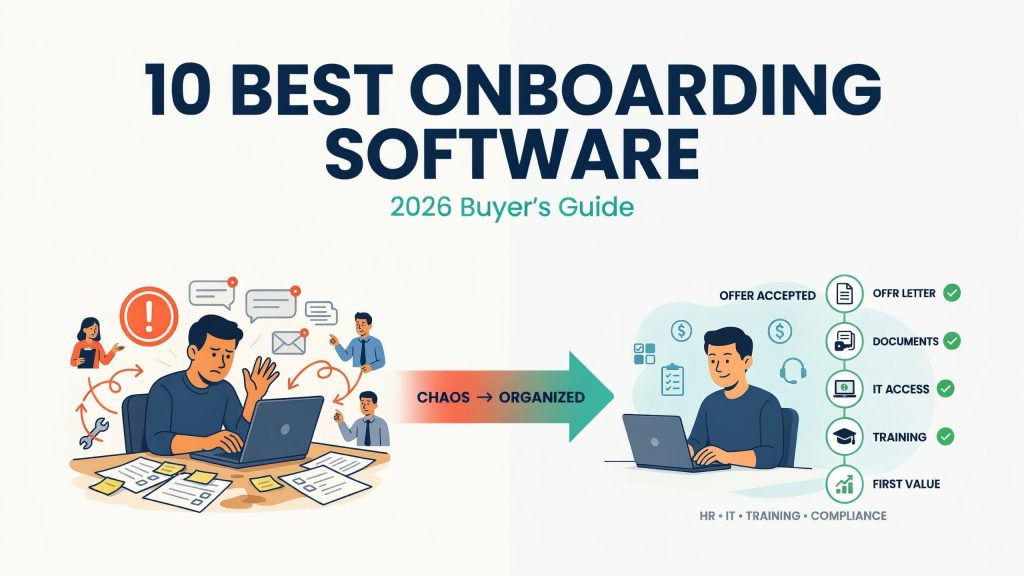
Most companies still treat onboarding as forms and a laptop. In 2026 that is how new hires quietly disengage before week two.
The offer gets accepted. Then nothing useful happens for ten days. HR chases I-9s. IT waits for a ticket that never quite matches the start date. The manager assumes “onboarding” is someone else’s checklist. The new hire logs into three portals, cannot find Slack, and spends day one watching a welcome video that was recorded two CEOs ago. By Friday they have completed paperwork and learned almost nothing about how work actually gets done.
That pattern is expensive. Early attrition, delayed first value, and IT bottlenecks are not culture problems first. They are workflow problems. The software you pick either closes those gaps or multiplies them.
The best onboarding software in 2026 does three jobs at once: collect compliance paperwork, provision access, and give the person a clear path to first value. Preboarding starts at the accepted offer, not at 9 a.m. on Monday. Payroll and benefits data should never be re-keyed. Manager, IT, and buddy tasks need owners and deadlines. Remote and hybrid teams need apps and devices without a week of Slack DMs. Training should be a path, not a folder of PDFs. If you hire globally or use contractors, the same journey has to survive different employment models.
This guide ranks ten solutions that actually show up in real People Ops stacks. It is not a feature dump. It maps tools to company size, hiring volume, and a decision most buyers still dodge: stay inside the HRIS, or add a dedicated journey layer.
Stay inside BambooHR, Rippling, Gusto, HiBob, or Workday when the employee record, payroll, and task list already cover 80 percent of the work. Add a journey platform like Enboarder when the experience itself is broken — managers do not show up, preboarding is silent, and first-30-day outcomes are luck. Add Trainual when the gap is knowledge, not forms. Add WorkBright or Click Boarding when volume and compliance are the real risk.
Read the next two sections before the rankings. If you skip them, you will buy the flashiest demo and still be chasing laptops in week two.
What Good Onboarding Software Must Do in 2026
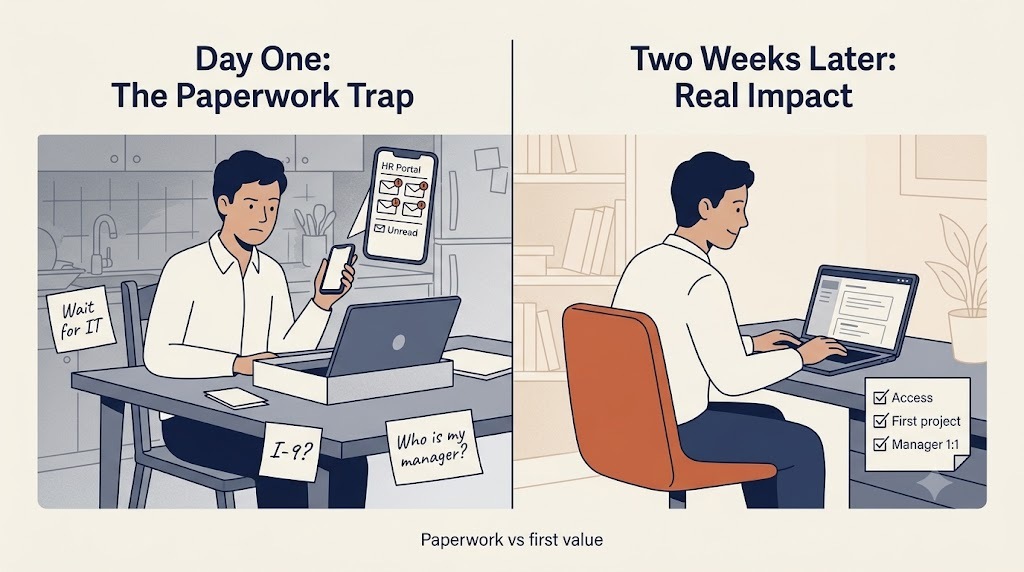
Good onboarding software is not a prettier packet. It is the system that turns an accepted offer into a working employee without a second source of truth.
Preboarding from accepted offer to day one. The clock starts when the candidate says yes. That window is where you collect documents, confirm start date and equipment, introduce the manager and buddy, and stop offer-to-start dropout. If your tool only “goes live” on day one, you bought a day-one portal, not an onboarding system.
Forms, e-sign, payroll, and benefits without re-keying. Name, address, tax elections, bank details, and benefits choices should flow once into the employee record. Re-entry is how I-9s, W-4s, and payroll setups drift. In 2026 this is table stakes for any HRIS-native product and a hard requirement if you run high volume.
Manager, IT, and buddy task orchestration. HR cannot complete onboarding alone. The tool has to assign work to the people who actually unblock the hire: laptop and accounts from IT, first-week plan from the manager, human context from a buddy. Tasks need owners, due dates, and visibility. A checklist that only HR sees is theater.
App and device provisioning for remote and hybrid teams. This is the 2026 gap most “onboarding modules” still miss. A new hire who cannot get email, Slack, SSO, and a configured device on day one is not onboarded. Rippling treats this as core. Most HRIS tools treat it as an integration project. Know which problem you have.
Training paths, not just checklists. Completing a form is not the same as knowing how to do the job. The software should sequence role-specific learning, policies, and first assignments. If all you have is “read the handbook,” time-to-productivity will stay anecdotal.
Global and contractor hiring where it is relevant. Employment type changes the workflow. A W-2 hire in Texas, an EOR employee in Spain, and a contractor in Brazil do not share the same packet, payroll path, or access rules. If that is your hiring motion, the tool has to handle it natively or you will run a second process in spreadsheets.
If a vendor cannot show those six jobs in a live workflow — offer accepted to first useful week — they are selling documents with a dashboard.
HRIS-Native vs Dedicated Onboarding Tools
This is the decision that saves or wastes a year.
Stay inside the HRIS when BambooHR, Rippling, Gusto, HiBob, or Workday already owns the employee record and can run packets, e-sign, checklists, and payroll setup. One system means one profile, fewer sync failures, and one place managers actually log in. For most companies under a few hundred people, that is the correct default. Rippling is the exception that also swallows IT. Workday is the exception that swallows the enterprise.
Buy a second system when the HRIS module is a checklist factory and the real failure is the journey. Enboarder earns its keep when you need multi-week, multi-channel orchestration across HR, managers, buddies, and systems you will not replace. WorkBright and Click Boarding earn it when volume, deskless hiring, or I-9 / E-Verify compliance is the bottleneck. Trainual earns it when new hires finish forms and still cannot run the process.
The expensive mistake is stacking a journey tool on an HRIS that already does 80 percent of the work, then asking two vendors who owns the employee record. Pick a system of record first. Add a layer only if the experience or the compliance edge case is still broken after that system is configured well.
The Top 10 Solutions
Rankings below are by buying problem, not by G2 stars. For each tool: who it is for, what it actually does well, where it breaks, and how pricing behaves. Part 1 covers the five platforms most teams evaluate first.
1. Rippling
Best for: Companies where onboarding must also set up payroll, apps, identity, and devices — typically tech-forward and distributed teams from roughly 50 to a few thousand people.
Rippling is the only mainstream platform where “we hired them” can mean the record, payroll, benefits, SSO, app licenses, and a shipped laptop move in one workflow. That is not marketing language. The product is built on a single employee graph, so department, location, and employment type can trigger downstream access without a Zapier graveyard. For lean IT teams, this is the difference between day-one access and a week of tickets. Rippling IT can also sit next to another HRIS if you are not ready to rip out BambooHR or Workday, which is a more honest 2026 option than most all-in-one pitches admit.
Strengths: True HR + IT onboarding. Strong preboarding and e-sign. Workflow automation that non-engineers can actually run. Global payroll and EOR paths if you are already in the Rippling ecosystem. Offboarding is the mirror image, which matters more than buyers admit during the demo.
Limitations: Modular pricing adds up fast once payroll, benefits, devices, and learning are on the quote. The admin surface is powerful and can feel heavy for a five-person People team that only needed packets. Culture and engagement features are thinner than HiBob. If your bottleneck is manager coaching and first-90-day belonging, Rippling will provision the laptop and still leave the human journey thin.
Pricing character: Core platform commonly cited around $8 per employee per month plus a small base fee, then modules on top. Implementation is a real line item. Model the fully loaded stack, not the homepage number.
2. BambooHR
Best for: SMB and mid-market teams that want a serious HRIS with strong checklists, packets, and e-sign — especially US-centric companies that already think in employee records, not device fleets.
BambooHR remains the default “we finally need real HR software” answer for a reason. Onboarding lives on the same record as time off, documents, and the org chart. Offer letters, new-hire packets, e-sign, and tasks for HR, managers, and IT are mature. Implementation is usually measured in weeks, not quarters. Employees actually use the mobile app, which sounds minor until you watch a mid-market rollout die because nobody opens the portal.
Strengths: Clean UX. Fast time-to-value. Packets and checklists that non-specialists can maintain. Enough structure for a growing HR team without enterprise process theater. Month-to-month flexibility is still more common here than with heavier platforms.
Limitations: App and device provisioning is not the product. You will integrate IT tools or accept tickets. Payroll is an add-on, not the center of gravity. Deep global employment is not why you buy it. Training content is light. If you are a 40-person SaaS company shipping MacBooks to three countries, BambooHR will organize the paperwork and leave IT to invent the rest.
Pricing character: Quoted per employee. Public ranges in 2026 still cluster around Core / Pro / Elite tiers in the roughly $10–$25 PEPM band, with small-team minimums that make it look expensive under ~25 employees. You pay for a real HRIS, not a cheap form tool.
3. Gusto
Best for: Small US teams that need payroll and onboarding in one simple flow — typically under 50 people, often with no dedicated People Ops hire.
Gusto wins when the risk is “this person cannot get paid correctly on day one.” Offer, tax forms, direct deposit, benefits context, and a self-serve new-hire flow sit next to payroll. That is the right design for a founder-led or office-manager-led company. The product is intentionally narrow. You will not build a six-week multi-persona journey in it, and you should not try.
Strengths: Lowest operational friction for US payroll-plus-paperwork onboarding. Clear pricing. New hires can finish the essentials before Monday without a training seminar. Good enough HR workflows for small teams that would otherwise live in Drive folders.
Limitations: Weak on IT provisioning, multi-system journeys, and serious training. Global hiring is not the core motion. Once you have a real HR function, recruiting depth, and performance process, Gusto starts to feel like a payroll product with onboarding attached — because that is what it is. Many teams outgrow it into BambooHR or Rippling rather than failing inside it.
Pricing character: Transparent small-business pricing. Simple plans are commonly listed around $49 per month plus $6 per person (some quotes sit near $46 + $6). Higher tiers add HR depth at a steeper per-person rate. Easy to budget. Easy to outgrow.
4. HiBob
Best for: Mid-market, culture-conscious, distributed teams that want onboarding inside a modern HRIS people will actually open.
HiBob’s onboarding is competent: structured workflows, offer-to-start tasks, and connections into the broader people platform. That is not why buyers pick it. They pick it because the rest of the system — org visibility, communications, recognition, people analytics — makes the new hire’s first month feel like joining a company rather than completing a compliance project. For distributed teams, that matters. A checklist in a dead portal loses to a platform employees already live in.
Strengths: High adoption relative to stodgier HRIS tools. Better culture and engagement layer than Rippling or classic BambooHR. Solid mid-market workflows and a product direction that treats people experience as more than forms. Reasonable fit when you are 100–500 employees and hiring across locations.
Limitations: Not an IT provisioning system. Pricing is quoted and usually sits above “simple SMB HRIS.” Implementation is longer than Gusto and often longer than a clean BambooHR rollout. If your pain is laptops, SSO, and SaaS licenses, HiBob will not replace Rippling. If your pain is payroll-only, Gusto is cheaper and faster.
Pricing character: Custom per employee. Budget mid-market HRIS money, not Gusto money. Implementation is part of the deal.
5. Workday
Best for: Enterprise HCM programs with complex, global onboarding — multiple countries, worker types, approvals, and a finance/HR operating model that already runs on Workday.
Workday onboarding is a business process, not a welcome app. That is the point. Effective dating, supervisory orgs, conditional steps, recruiting-to-HCM handoff, and audit history are what large employers actually need when a “simple checklist” would violate policy in three jurisdictions. If Workday is already the system of record, running onboarding somewhere else creates a permanent reconciliation job.
Strengths: Depth for global complexity. Native connection to core HR, payroll (where deployed), and workforce data. Configurable processes that security, legal, and works councils can live with. The right backbone when you have 2,000+ employees and real entity complexity.
Limitations: Slow to change. Expensive. Easy to configure into a maze. The employee experience is rarely why anyone loves Workday. Time-to-productivity features, warm manager nudges, and multi-channel journey design are why enterprises still add Enboarder on top. If you are 200 people “preparing to scale,” Workday is usually overkill and will consume the team that was supposed to improve onboarding.
Pricing character: Enterprise contract. Think implementation program plus annual software, not a PEPM you pick off a page. If you need a number for a deck, other 2026 buyer guides still cite mid-six to seven figures a year for broader HCM — onboarding is not a cheap sidecar.
6. Deel
Best for: International employees, contractors, and EOR-led hiring — especially when the hard part is legal employment in a country where you have no entity.
Deel is not an onboarding boutique. It is a global employment platform that happens to run a clean onboarding path because it has to. A contractor in one country, an EOR employee in another, and a payroll employee on your own entity do not share the same contract, tax packet, or benefits path. Deel’s value is that the workflow changes with the worker type instead of forcing everyone through a US W-2 packet with a “we’ll figure out Spain later” note.
Onboarding here means compliant contracts, local documents, payment setup, and a worker profile that payroll can actually use. For EOR hires, Deel is the legal employer, so local onboarding and statutory setup sit inside their process rather than yours. That is the point. You should not rebuild country-by-country packets in BambooHR and hope legal reviews them in time.
Strengths: Breadth across contractors, EOR, PEO, and global payroll. Fast path from “we want this person” to a signed, payable relationship. Automated compliance for the employment model you selected. Useful when your HRIS is domestic and your headcount is not.
Limitations: It will not replace Rippling for device and app provisioning, or Enboarder for a designed first-90-day experience. Deel HR exists and is inexpensive, but culture, manager orchestration, and deep IT onboarding are not why you buy it. Country coverage is wide; country depth still varies. EOR list price looks high until you price a local entity. Then it often looks cheap. Still model pass-through statutory costs, deposits, and benefits — the platform fee is not the total cost of hire.
Pricing character: Modular and unusually public. Contractor management commonly listed at $49 per contractor per month. EOR commonly listed at $599 per employee per month. Contractor of Record and US PEO are separate lines. Deel HR is a low PEPM add-on and sometimes bundled. Quote the worker mix, not a blended fantasy number.
7. Enboarder
Best for: Dedicated journey work when the HRIS already owns the record and the experience is still failing — mid-market to enterprise, multi-system, manager-dependent onboarding.
Enboarder sits above the ATS and HRIS. That architecture is the product. Offer accepted in Greenhouse, worker created in Workday or BambooHR, then Enboarder runs the human operating system: preboarding messages, manager prompts, buddy intros, role-specific sequences, multi-channel nudges, and now AI assistants and agents that generate 30/60/90 plans and chase stalled steps.
This is the tool you buy when forms complete and people still ghost, managers still forget week-one 1:1s, and IT still gets pinged on Monday morning. In 2026 the platform is leaning hard into agentic AI. Treat that as useful orchestration, not magic. The journeys still need owners and content. AI that writes a ramp plan from a stale job description will produce a stale ramp plan.
Strengths: Best-in-class journey design. Conditional flows by role, location, and employment type. Delivery in email, SMS, Slack, Teams — the channels people already use. Strong ATS/HRIS integration story. Explicitly built to coordinate HR, manager, buddy, and IT without becoming the system of record.
Limitations: Second system. Second login. Second implementation. You still need an HRIS for the employee file. Slack can feel like a bot layer rather than a conversation. Pricing is quoted, implementation is weeks, and content work is the part vendors under-scope. If your HRIS module is unused because nobody configured it, fix that first. Enboarder does not rescue a messy record.
Pricing character: Custom. Public anchors in 2026 cluster from high four figures to mid-five figures a year for smaller deployments, with enterprise contracts higher. Implementation and SMS/compliance add-ons show up after the first quote. Cost should scale with journey complexity and hiring volume, not with your desire for a prettier portal.
8. Greenhouse (ATS-to-onboarding handoff)
Best for: Teams where the main gap is recruiting-to-start continuity — offer accepted in Greenhouse, then silence until HR invents a packet.
Greenhouse Onboarding (and the lighter Welcome tier) exists to keep candidate data moving. The hire is already in the ATS. Names, role, start date, hiring manager, and offer documents should not be retyped into a spreadsheet “for onboarding.” Greenhouse can launch a welcome plan, assign tasks, collect signatures on the fuller Onboarding tier, push data toward BambooHR, ADP, Workday, and keep 30-day goals visible to the same people who ran the search.
Use it when TA owns the first impression and HRIS onboarding is either thin or late. Do not use it as your long-term system of record. Greenhouse is a hiring platform with an onboarding extension. Payroll, benefits, devices, and year-two employee data live elsewhere.
Strengths: No cold-start problem if you already run Greenhouse Recruiting. Cleanest offer-to-preboarding handoff in this list. Structured plans by office, role, and team. Good enough tasking and welcome experience to stop the “wait, did anyone tell IT?” week.
Limitations: Not payroll. Not IT provisioning. Not a global employment engine. Feature access is tier-sensitive — fuller onboarding is often an add-on or bundled only on higher recruiting plans. If you are not already paying for Greenhouse, do not buy the ATS to solve onboarding.
Pricing character: Recruiting contracts are custom and usually the real expense. Onboarding is commonly an add-on or a higher-tier include. Buyer-reported ATS ranges in 2026 still run from low five figures annually for smaller teams into tens of thousands for mid-market. Price the handoff, not a standalone onboarding suite.
9. Trainual (SOP and training layer)
Best for: When the problem is knowledge transfer, not paperwork. Growing companies where new hires finish forms and still cannot run the job.
Trainual is a training and SOP system that borrowed onboarding language because that is when people notice the wiki is dead. Role-based paths, tests, acknowledgments, AI-assisted SOP drafts, and completion tracking are the product. Pair it with Gusto, BambooHR, or Rippling. Do not ask it to collect I-9s, ship laptops, or run payroll.
This is the honest split most “all-in-one onboarding” decks blur. Compliance gets you legally employed. Training gets you useful. If week two is a tour of tribal knowledge in Slack, you have a Trainual problem even if your HRIS checklists are green.
Strengths: Fast way to turn “ask Maria” into a path. Role assignment so a new AE does not get the warehouse SOP pile. Tracking that shows who finished what. AI drafting that makes documentation less painful, provided a human still owns accuracy.
Limitations: Not an HRIS. Not provisioning. Content quality is your problem. Empty Trainual is worse than a messy Google Drive because now you have a unused system and the same tribal knowledge. Implementation fees are common. If you will not maintain SOPs, do not buy the library.
Pricing character: Seat- and tier-based, often quoted now. Market figures in 2026 still show small-team plans in the low-to-mid hundreds per month on annual billing, with a one-time implementation fee often around $1,000. You are paying for a knowledge system. Budget time for authors, not just licenses.
10. WorkBright / Click Boarding
Best for: High-volume, deskless, seasonal, or compliance-heavy hiring — warehouses, healthcare, hospitality, field teams, multi-state hourly work.
These two are grouped because they solve the failure mode HRIS modules handle worst: a thousand hires who will complete onboarding on a phone, in a language HR did not design for, with I-9 and state forms that cannot be “close enough.”
WorkBright is forms- and I-9-first. Remote I-9, OCR, E-Verify, mobile completion, reminders, and audit-ready files are the core. In 2026 they have pushed further into managed I-9 operations (AI plus human review) for employers who do not want that risk sitting on a coordinator’s desk. If your pain is “we cannot get Section 2 done before day three,” start here.
Click Boarding sits between ATS and HRIS as a dedicated transition platform: preboarding, onboarding, crossboarding, offboarding, compliance packets, and enterprise workflow control. It is the better fit when volume is high and the journey still needs orchestration across many stakeholders, not just a mobile I-9.
Strengths: Mobile completion that deskless workers will finish. Compliance depth US hourly employers actually need. Integrations into ADP, Workday, BambooHR, and major ATS tools so the packet does not live in a side database forever. Built for surge hiring rather than 12 professional hires a year.
Limitations: Neither replaces a full HRIS. Culture journeys are not the point. Global EOR is not the point. If you hire 40 salaried remote engineers a year, this is the wrong aisle. WorkBright is narrower and sharper. Click Boarding is broader and more “enterprise process.” Pick the failure mode.
Pricing character: Quoted around volume. WorkBright often prices by hiring volume or I-9/onboarding tier rather than a simple PEPM. Click Boarding is enterprise-quoted. Seasonal employers should model per-hire cost, not annual headcount.
How to Choose
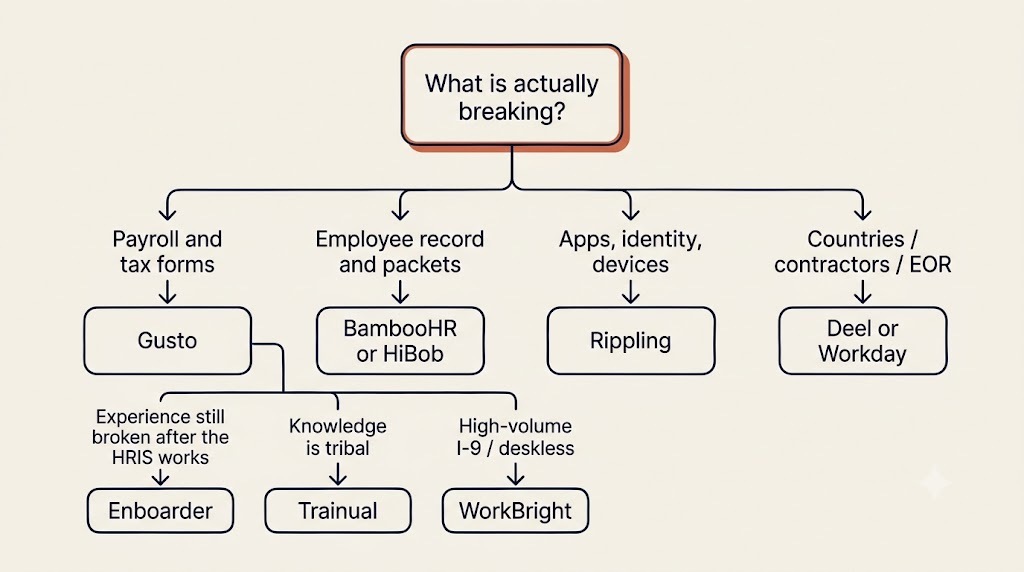
Ignore category awards. Name the job that is failing, then pick the system that owns it.
Small company with payroll pain → Gusto.
Under ~50 US employees, founder or office manager running HR. The risk is tax forms, direct deposit, and a first paycheck. Gusto is the shortest path. Add Trainual only if new hires cannot do the work after they get paid.
Growing HR team, US-centric → BambooHR.
You have (or are about to have) a People person. You need records, packets, e-sign, PTO, and manager tasks in one place. Stay here until IT provisioning or global employment becomes the weekly fire.
Tech company with many tools and devices → Rippling.
The hire is not onboarded until email, Slack, GitHub, MDM, and a laptop exist. If that sentence is true in your company, stop evaluating “HRIS onboarding modules” as if they were equivalent.
Global hiring → Deel or Workday.
No entity in-country, mix of contractors and employees: Deel. Already an enterprise HCM with entities, works councils, and finance integration: Workday. Rippling sits between those poles if you want global employment plus IT on one graph.
Experience and multi-system journeys → Enboarder.
The HRIS works. The first 30 days do not. Managers are the bottleneck. Buy the journey layer, not a second record system.
Recruiting-to-start is the leak → Greenhouse Onboarding.
Candidates accept and then fall into a gap between TA and HR. Close the handoff where the offer already lives.
Knowledge is the leak → Trainual.
Paperwork is fine. Execution is tribal.
Volume and I-9 risk → WorkBright or Click Boarding.
Deskless, seasonal, multi-state, audit-sensitive. Do not make warehouse new hires create a BambooHR account on a laptop they do not have.
Simple matrix:
| Situation | First pick | Add only if… |
|---|---|---|
| <50, US, payroll-first | Gusto | Training is chaotic → Trainual |
| 20–300, US HR team | BambooHR | Devices/apps are the fire → Rippling IT or full Rippling |
| Tool-heavy / remote tech | Rippling | Journey quality still poor → Enboarder |
| Mid-market, distributed, culture | HiBob | Global employment depth → Deel alongside |
| Enterprise HCM already in place | Workday | Experience broken → Enboarder |
| Multi-country, no entities | Deel | Domestic HRIS still needed → keep BambooHR/HiBob |
| ATS is Greenhouse, handoff is messy | Greenhouse Onboarding | Compliance volume → WorkBright |
| Deskless / seasonal / I-9 | WorkBright or Click Boarding | Keep HRIS as record |
Implementation Tips That Actually Improve Time-to-Productivity
Start the journey at offer, not day one. Everything useful — equipment, accounts, tax forms, manager intro, first-week plan — has a lead time. A Monday start with a Friday IT ticket is a process you designed, not a software limitation.
Assign owners by name: HR for the record and compliance, manager for role ramp and first meetings, IT for access and devices, buddy for the unofficial map of how work happens. Software without owners becomes a dashboard of red tasks nobody believes.
Measure 30/60/90 outcomes, not just form completion. Useful metrics: offer-to-start dropout, day-one access ready (email, SSO, device, payroll), time to first completed real work, manager 1:1 completion in week one, 90-day performance or ramp against a written plan, 90-day attrition. Packet completion is a hygiene metric. It is not productivity.
Do not buy a second tool if the HRIS already covers 80 percent of the workflow and you have not configured it. Most “we need Enboarder” conversations are actually “nobody built the BambooHR checklists or named an IT owner.” Configure the system of record. Run two real cohorts. Then spend money on the gap that remains.
Keep content short and role-specific. A 40-item universal checklist trains people to ignore checklists. Split by entity, country, employment type, and job family. Review quarterly. Onboarding software rots at the speed of org changes.
Conclusion
The best onboarding software in 2026 is the one that removes repeat data entry and makes the first 30 days obvious.
Pick the system of record you already need for HR or payroll. Let Rippling win when access and devices are part of employment. Let Deel or Workday win when the employment model itself is the complexity. Add a journey layer only if managers and new hires still cannot see what “good” looks like after the record system is working. Add training software when the wiki is the bottleneck. Add a compliance specialist when I-9s and surge hiring are the bottleneck.
The common failure is buying a portal to hide an ownerless process. Software can assign the laptop, the W-4, and the week-one 1:1. It cannot care about the hire if no human is on the hook. Choose the smallest stack that covers paperwork, access, and first value. Then measure whether week four looks like a working employee or a completed checklist.
FAQs
What’s the best onboarding software for a company under 50 people?
Gusto if payroll and tax setup are the pain. BambooHR if you want a real HRIS and can live without deep IT provisioning. Rippling only if you already run a pile of SaaS tools and devices. Do not buy Workday or Enboarder at this size unless you have an unusual constraint.
Do we need a dedicated onboarding tool if we already have BambooHR or Gusto?
Usually no. Use the native packets and checklists first. Add Enboarder if the experience across managers and systems is the failure. Add Trainual if knowledge is the failure. Add WorkBright if I-9 and mobile volume are the failure.
Rippling vs BambooHR — which is better for onboarding?
Rippling if onboarding includes apps, identity, and devices. BambooHR if onboarding is packets, tasks, and a clean employee record for a US-centric HR team. They are not substitutes. One is a workforce platform. One is an HRIS that does onboarding well.
How do we onboard remote employees without IT becoming the bottleneck?
Trigger access from the employee record, not from a ticket written on day one. Rippling is the direct answer. If you keep another HRIS, use Rippling IT standalone or a disciplined identity tool with group rules by department and start date. Ship devices against the accepted offer, not the first login attempt.
What’s the best option for hiring in multiple countries?
Contractors and EOR without local entities: Deel. Complex enterprise with existing entities and HCM: Workday. Growing tech company that also needs devices: Rippling. A domestic HRIS plus Deel for the international slice is a normal, sane stack.
Can onboarding software also handle training and SOPs?
HRIS tools handle acknowledgments and light courses. Real process training is Trainual or your LMS. Enboarder can sequence enablement and generate ramp plans, but it is not your SOP library. Do not force one product to be record, journey, and knowledge base unless you like mediocre versions of all three.
How long should onboarding software implementation take?
Gusto: days to a couple of weeks. BambooHR: often 4–6 weeks. Rippling: a few weeks for a clean core, longer with IT and payroll modules. HiBob: commonly 6–8+ weeks. Enboarder: plan 6–10 weeks to a first live journey. Workday: a program, not a project. If a vendor promises “live Monday” for a global HCM, they are selling a pilot, not a rollout.
What should we measure besides completed paperwork?
Offer-to-start show rate. Day-one access completeness. Time to first independent piece of real work. Manager and buddy task completion. 30/60/90 ramp against a written plan. 90-day attrition and early engagement. Paperwork is necessary. It is not the outcome.
Is Workday overkill if we’re not a huge enterprise?
Almost always. Under ~1,000 employees, and without multi-entity finance/HR complexity, you will spend the implementation paying for governance you do not have staff to run. BambooHR, HiBob, or Rippling will get a 200-person company further, faster.
What’s the biggest onboarding software mistake companies make?
Buying a second platform before using the one they have, then measuring success as “forms complete.” The expensive version is an unused HRIS module plus a journey tool plus a training tool, with IT still on Slack, and no owner for day-one access. Pick a record system. Name four owners. Start at the offer. Measure week four.