
$5M ARR. That’s roughly $416K in monthly recurring revenue. In 2026, a handful of AI-native startups are blasting past it in months, not years—thanks to vertical tools, product-led growth, and leverage that didn’t exist even two years ago. But for most founders, it’s still a brutal slog. The majority of SaaS companies take 3–5+ years to get there, if they ever do. Many flame out chasing vanity metrics, ignoring unit economics, or burning out in crowded markets where acquisition costs keep climbing.
This isn’t a hype piece promising shortcuts. It’s a tactical playbook for building something real: ruthless focus on urgent customer pain, smart leverage with 2026 tools (AI coding agents, no-code accelerators, automation), and systems that compound. You’ll hear anonymized founder stories, data-backed benchmarks, repeatable frameworks, and honest caveats—“This worked for X, but Y is harder now.”
I’ve pulled from recent benchmarks (High Alpha, ChartMogul, a16z-era reports), fast-growth cases like Cursor, Harvey, and vertical AI plays, and the realities of higher CAC, AI churn waves, and economic selectivity. The goal? Give you a clear path to $5M ARR in 18 months—if you have the prerequisites and execute without delusion. Let’s dive in.
Reality Check & Prerequisites
Let’s kill the fantasy first: 18 months to $5M ARR is exceptional, not normal. Top-quartile AI-native startups can hit it faster, with some reaching $5M+ in 12 months, but they often have prior experience, funding, viral mechanics, or deep domain moats. Median SaaS still grinds slower.
2026 Context: AI is everywhere, compressing build times but raising the bar on differentiation. Acquisition costs are up, markets are crowded with me-too tools, and buyers are selective amid economic caution. Vertical AI/specialized solutions win because they embed industry data and workflows that general LLMs can’t match. Gross margins for AI-native products are often compressed (60-75%) due to inference costs, but growth can be 2-3x faster than traditional SaaS.
Founder Prerequisites:
- Deep domain expertise (or fast access to it): Insiders like Veeva’s Peter Gassner win with lived pain; outsiders succeed by embedding deeply via interviews and pilots. Mixed evidence shows both work if you obsess over customers.
- Technical edge: A strong technical co-founder, or you’re proficient with no-code/low-code + AI (Cursor, Lovable, v0, Bubble). Solo non-technical founders can ship MVPs but struggle scaling without hires.
- Capital and resilience: Seed/pre-seed runway (realistically $500K–$2M+ depending on burn), plus the grit to handle rejection and pivots. Resilience beats pedigree—founders who don’t quit win.
- Team start: Often just founders + freelancers early. Two co-founders tend to grow fastest.
Honest caveat: Without prior SaaS experience or a hot vertical, adjust expectations to 24–36 months. Track your personal “founder-market fit” early. If you lack these, partner up or validate smaller first.
Idea Validation & Problem Selection
Don’t build in a vacuum. In 2026, winners pick urgent, paid pains in growing verticals where AI can deliver outsized leverage (e.g., legal, healthcare, construction, accounting, field services).
Use AI for Research:
- Prompt tools like Claude/Cursor to synthesize reports, Reddit/X threads, and competitor gaps.
- Search for “jobs to be done” in niches with high willingness-to-pay and low churn potential (e.g., compliance, workflow automation that saves labor hours).
Validation Playbook (Do this in 4–6 weeks):
- Customer Interviews: Talk to 30–50 potential users (your network, LinkedIn, forums). Ask: “What’s the most painful part of [workflow] today?” “How much would you pay to fix it?”
- Landing Page Tests: Build a quick page with v0 or Webflow. Drive traffic via targeted ads/content. Measure sign-ups, waitlist, or pre-orders.
- Paid Pilots: Offer a beta at discounted rate ($500–$5K) to 5–10 customers. Real money validates better than surveys.
- Waitlists + LOIs: Aim for 100+ committed leads.
Criteria for $5M Potential:
- TAM: Large enough but focused—vertical > horizontal for defensibility.
- Willingness to Pay: ACV $10K–$100K+ for sales-led; lower for PLG.
- Low Churn Potential: Sticky workflows, high switching costs, expansion via usage/AI upsells.
- Defensibility: Proprietary data, network effects, or AI trained on vertical specifics.
Story Example: Think of founders in personal injury law or HVAC who built narrow AI agents for demand letters or scheduling. They dominated small markets fast because the pain was acute and data-rich.
Caveat: Avoid “AI wrapper” ideas. Buyers want production evidence, not demos. Test unit economics early—aim for LTV:CAC >3:1 from day one.
Actionable Checklist:
- 30+ interviews completed
- Validated problem with paying pilots
- Clear ICP and pricing hypothesis
- Competitor moat analysis
Build Phase (Months 1–4): MVP to Product-Market Fit
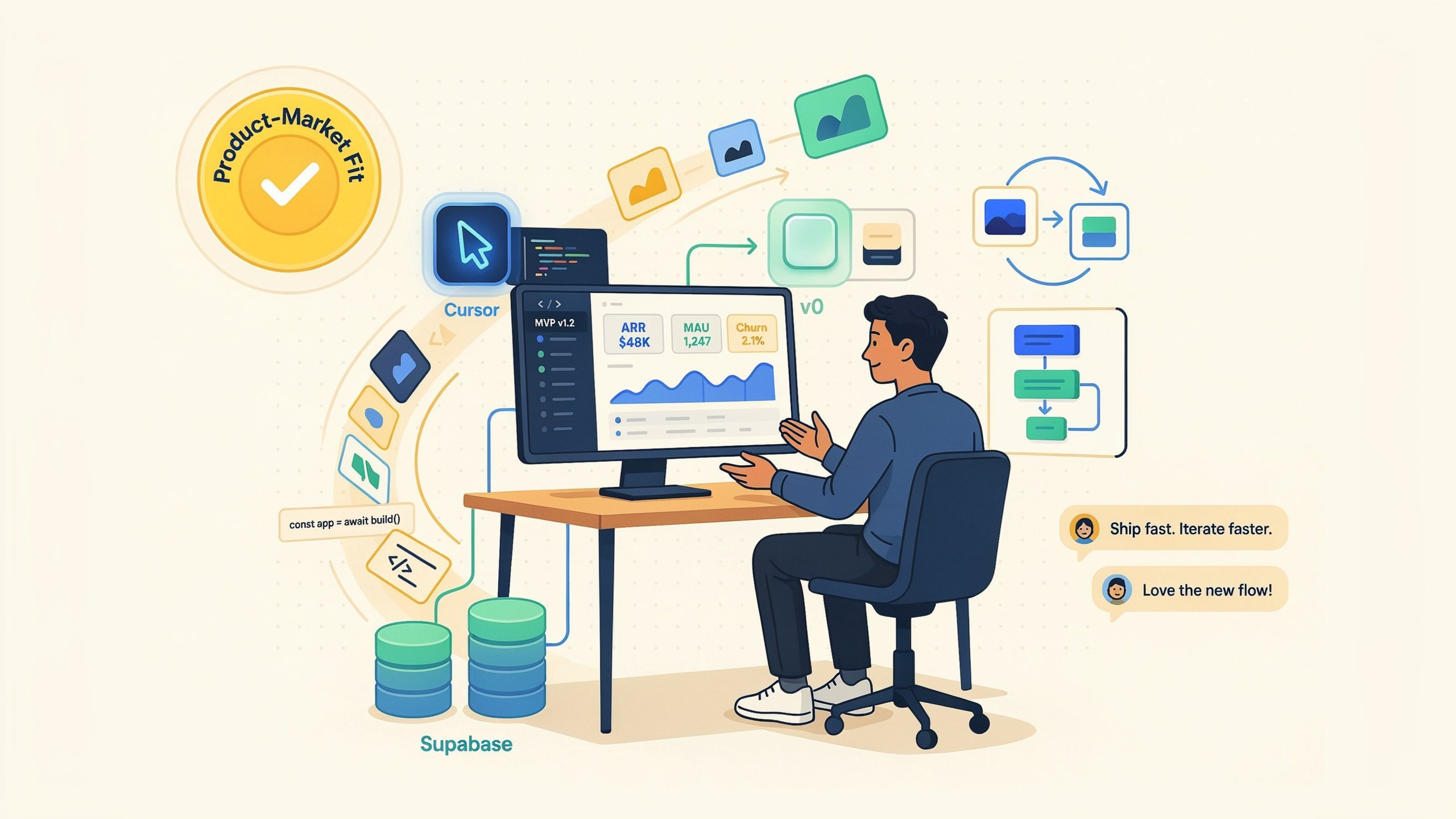
Speed is your superpower in 2026. Use AI to compress what used to take months into weeks.
Tactics for Rapid Iteration:
- AI-First Stack: Cursor or Lovable for full apps (natural language to React + Supabase backend). v0 for polished UIs. Bubble for complex logic if non-technical. Export code for ownership.
- Core Features: Solve one killer problem exceptionally. E.g., ambient note-taking in healthcare or contract review in legal. Add AI deeply—don’t bolt it on.
- MVP Scope: Auth, core workflow, basic dashboard, payments (Stripe). Prioritize activation metrics (e.g., first valuable action in <10 minutes).
- Early Team: Founders + contractors/freelancers (Upwork, etc.). Outsource design/QA initially.
Path to PMF:
- Private beta with 10–20 users.
- Iterate weekly based on usage data and feedback.
- Metrics to hit: High activation rate (>40–50%), qualitative “I can’t live without this” feedback, and initial retention.
Launch Strategy: Private beta → early paying customers. Aim for 10–20 MRR customers fast via founder outreach. Use product-led onboarding (tours, templates, AI assistants).
Real-Talk: AI speeds building but introduces bugs and hallucinations—test rigorously. Many MVPs fail because they’re too generic. Focus on delight in the core job.
Timeline Table (Months 1–4):
| Month | Focus | Key Milestones | Tools |
|---|---|---|---|
| 1 | Research & Core Build | Wireframes, backend schema, auth | Cursor/v0, Supabase |
| 2 | Iteration | Beta invite, core feature polish | User testing, Lovable |
| 3 | Onboarding & Payments | First pilots, analytics | Stripe, Mixpanel |
| 4 | PMF Validation | 10+ paying, <20% churn early | Feedback loops |
Caveat: No-code shines for speed but may need rewrite for scale. Plan for it.
Go-to-Market & Early Traction (Months 4–9): Reaching ~$500K–$1M ARR
Now ship and sell. Early traction is founder-led.
Acquisition Channels in 2026:
- Content/SEO + AI Personalization: Long-form guides, vertical case studies. AI for personalized outreach/content at scale.
- Partnerships & PLG: Embed in existing workflows; viral loops via sharing.
- Paid: Careful—focus on high-intent, retargeting. CAC payback <12 months target.
- Founder-Led Sales: Do the calls yourself initially. Document playbooks for later hires.
Pricing & Packaging: Tiered + usage-based (especially AI features). Start with value pricing tied to outcomes (e.g., hours saved).
Metrics Obsession:
- 40–60% MoM early growth (top quartile higher for AI).
- Churn <10% (aim higher for retention).
- Track NRR early—AI-native can struggle but improves with B2B shifts.
Sales Motion: Founder closes first deals, then hire AEs around $500K–$1M. Solutions engineers over pure SDRs for complex AI demos.
Story: Many fast growers used community (Discord, forums) and product virality before heavy sales. Focus on expansion revenue from day one.
Pitfalls to Avoid Here: Ignoring economics, over-relying on paid without organic base, weak onboarding.
Checklist for This Phase:
- First 50–100 customers
- Documented sales playbook
- Dashboard with core KPIs (ARR, churn, CAC)
- Pricing tested with real data
Scaling to $5M ARR (Months 9–18): Systems, Team & Capital
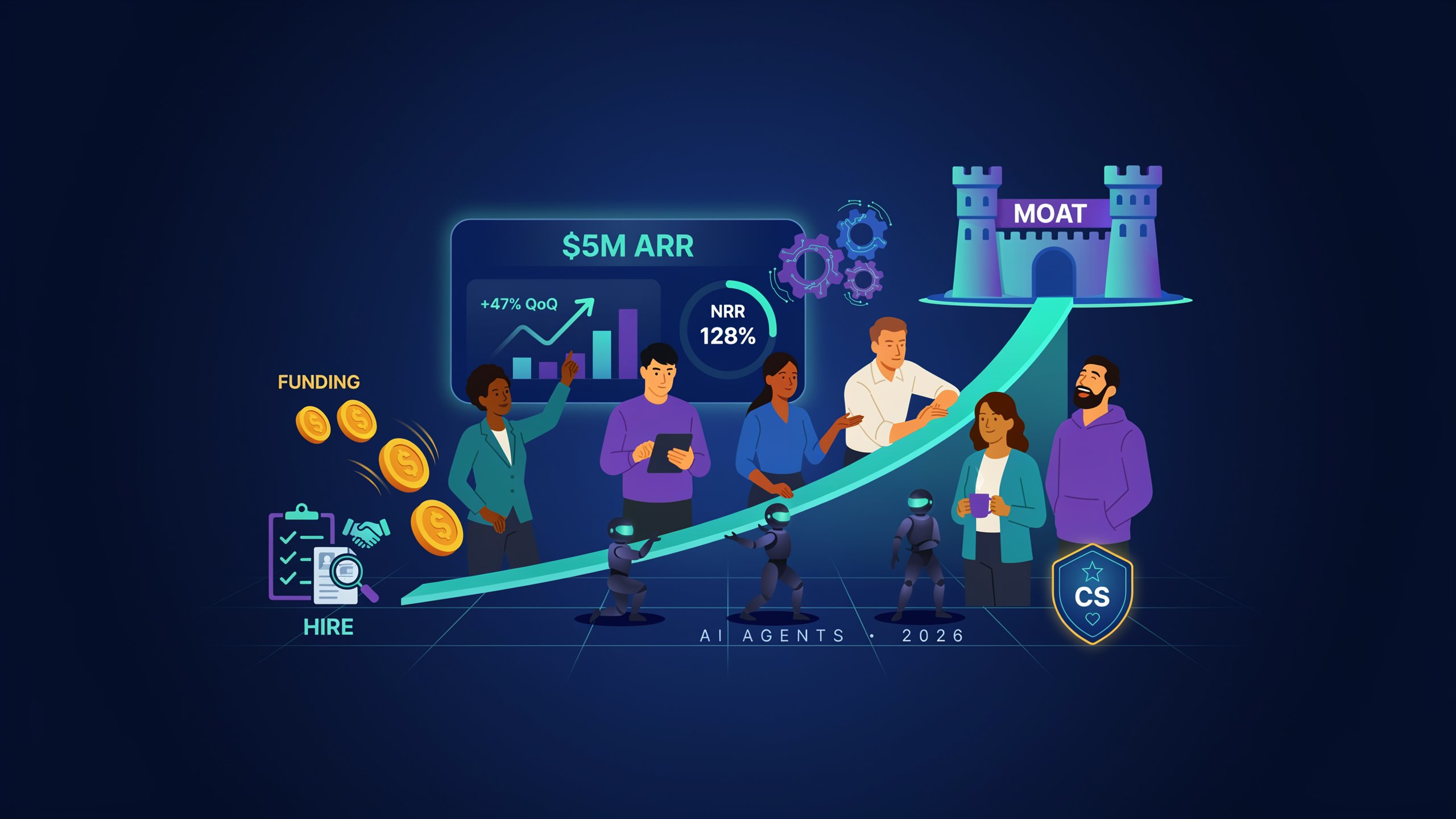
You’ve validated, built, and hit early traction. Now shift from survival to systems. This phase separates the $1M survivors from the $5M compounders. In 2026, AI leverage is your unfair advantage—use it for automation, personalization, and efficiency that traditional SaaS couldn’t match.
Hiring Playbook: Hire deliberately. Stay lean: target $300K–$700K revenue per employee early. Key roles and timing:
- Engineering: Add 1–2 after PMF to own reliability and AI integrations (Cursor-powered velocity helps here).
- Sales/CS: First AE around $500K–$1M ARR (after you’ve documented the playbook). Customer Success earlier for retention. Prioritize solutions engineers who can demo production AI value.
- General: Use contractors/freelancers heavily. Two co-founders often scale best; bring in ops/finance as you approach $2M+.
Timeline Framework:
- Months 9–12: Stabilize at $1M–$2M ARR. Implement core processes.
- Months 12–18: Accelerate to $5M via expansion + new logos. Build repeatable motions.
Retention & Expansion Systems: AI churn is real early on—focus on shifting to committed B2B usage.
- Onboarding: <15-minute time-to-value with AI-guided tours, templates, and proactive check-ins.
- Customer Success: Quarterly business reviews, usage analytics, and AI-driven upsell triggers (e.g., “Your team could save 20 more hours with Feature X”).
- Metrics: Target <10% churn, 110%+ NRR. Expansion becomes the engine beyond $2M ARR.
Funding: Bootstrap vs. Raise:
- Bootstrap: Possible in strong PLG/vertical niches with high margins. Many solopreneurs and small teams hit meaningful revenue this way.
- Raise Timing: Seed after PMF ($100K–$500K MRR). Series A around $1M–$3M ARR with strong traction (aim for Rule of 40+). AI commands premiums, but prove durable growth and unit economics.
- Caveat: Capital is strategic—use it to accelerate proven channels, not fix broken ones. Economic selectivity means tighter terms; focus on efficient growth.
Operations & Culture:
- KPIs Dashboard: ARR, MRR growth, churn, CAC payback (<12–18 months), LTV:CAC (>3:1), Rule of 40. Update weekly.
- Processes: Document everything (Notion + AI agents). Automate support, billing, and reporting.
- 2026 Leverage Tools: AI for customer support deflection, personalization at scale, code review, and internal agents. Stacks like Cursor + Supabase + n8n keep teams tiny yet powerful.
- Culture: Motivate with ownership and resilience. Combat burnout with focus—say no to distractions in crowded markets.
Actionable Scaling Checklist:
- Hired first non-founder (sales/CS)
- NRR >110%, CAC payback tracked
- Funding runway modeled for 18+ months
- AI automation covering 30%+ of repetitive tasks
- Weekly ops review with core metrics
Honest Note: Scaling introduces new failure modes—hiring too fast kills culture and economics. Many hit walls at $2M–$3M because they ignored retention. Stay customer-obsessed.
Common Pitfalls & How to Avoid Them
Most attempts die here. Avoid these:
- Building in Isolation: No customer feedback loop. Fix: Weekly interviews + usage data obsession.
- Ignoring Unit Economics: High CAC, low margins, poor LTV. Fix: Model everything before scaling spend. Target payback <12–18 months.
- Chasing Vanity Metrics: User growth without revenue. Fix: Obsess over paying customers and expansion.
- Burnout: Founder does everything. Fix: Delegate early with AI/contractors; protect focus time.
- Legal/Financial Basics: Messy cap table, taxes, incorporation. Fix: Use Stripe Atlas or equivalent early; consult pros for equity and compliance.
Other Killers: Feature bloat instead of depth, weak defensibility in AI era, or failing to adapt to 2026 realities (rising inference costs, buyer demand for ROI proof).
Framework: Quarterly “Kill Review”—list assumptions and test them ruthlessly.
Real-World Examples & Lessons
- Cursor/Anysphere: Blasted to massive ARR in <3 years with AI-native coding tools. Lesson: Deep vertical integration + developer love wins fast.
- Harvey (Legal AI): $190M+ ARR trajectory via specialized workflows. Lesson: Narrow, data-rich verticals create moats.
- Sierra & Vertical Agents: Rapid scaling in support/sales. Lesson: Production evidence > demos; AI agents eating horizontal SaaS.
- Bootstrapped Wins: Solopreneurs using Lovable/Cursor hitting $1M+ ARR lean. Lesson: Leverage compounds for small teams.
Key Takeaways: Speed via AI, but durability via systems and customer pain. Top performers maintain high NRR and Rule of 40 even at scale.
Conclusion
Hitting $5M ARR in 18 months is a milestone, not the destination. It proves you can build something people pay for and use daily. The real game is the long-term moat: proprietary data, team culture, and relentless leverage.
In 2026, winners blend human resilience with AI superpowers. Stay focused, honest about trade-offs, and motivated by impact—saving customers time/money in meaningful ways.
Final Motivation: You don’t need perfect timing or unlimited capital. You need ruthless prioritization, customer obsession, and the systems outlined here. Many have done versions of this. You can too.
Next Steps Checklist:
- Complete idea validation this week
- Ship MVP in 30–60 days
- Secure first 5–10 paying customers
- Review metrics weekly
- Iterate or pivot fast
Build meaningfully. The universe rewards those who ship, learn, and compound.
FAQs
Is it even possible to hit $5M ARR in 18 months in 2026 without a huge team or funding?
Yes, but rare—usually needs strong domain fit, AI leverage, and PLG/viral elements. Many do it leaner than before, but most realistic timelines are longer without prior traction.
What’s the best niche or idea to go after right now for fast SaaS growth?
Vertical AI in high-pain industries: legal workflows, healthcare documentation, field services, accounting compliance. Narrow beats broad.
How much money do I realistically need to start?
$100K–$500K+ runway for validation/build. More for paid acquisition. Bootstrap where possible.
Should I bootstrap or raise capital? When?
Bootstrap for control if metrics are strong. Raise post-PMF for acceleration, ideally with $1M+ ARR traction.
What tools are people actually using to build fast in 2026?
Cursor, Lovable, v0 for AI coding/UI; Supabase/Stripe; n8n for automation. Mix with Bubble for complex logic.
How do you get your first 10 paying customers quickly?
Founder outreach, paid pilots, communities, and strong onboarding. Solve one acute pain exceptionally.
What metrics should I obsess over at each stage?
Early: Activation, churn, PMF feedback. Mid: MoM growth, CAC payback. Late: NRR, Rule of 40, efficiency.
How do you handle churn and keep customers happy as you scale?
Proactive CS, AI personalization, usage-based value, and constant iteration. Shift to enterprise where sticky.
I’m technical but hate sales — can I still make this work with PLG?
Absolutely. Strong PLG + content/community can reduce sales reliance, especially in dev/creator tools.
What are the biggest mistakes that kill most SaaS attempts in the first year?
No validation, poor economics, isolation from customers, burnout, and lack of focus. Test assumptions early and often.
This playbook equips you. Execute consistently—the results compound.