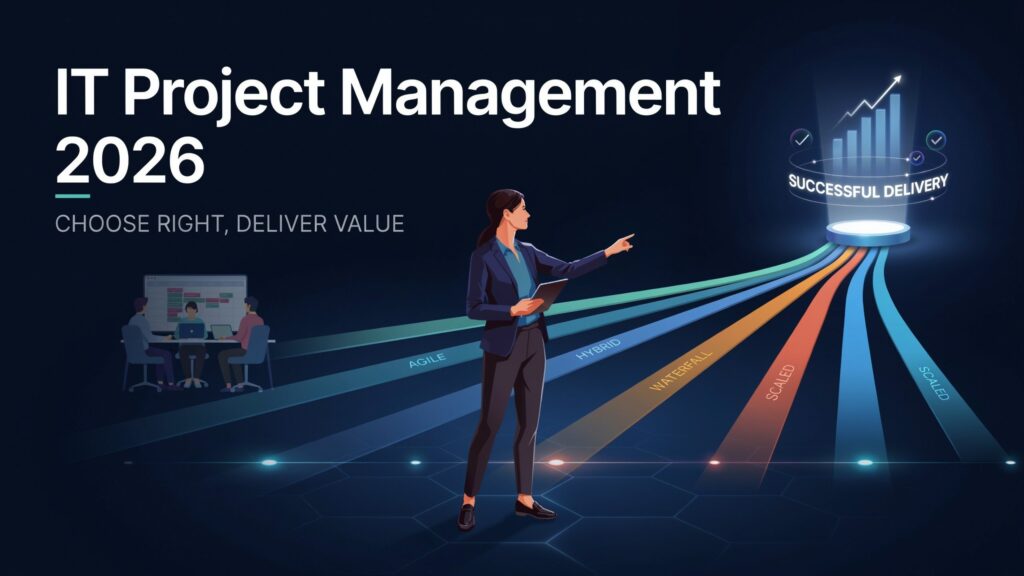
I’ve led, advised on, and rescued dozens of IT projects across industries — from fintech and healthcare to manufacturing and government. The one thing that consistently separates successful projects from expensive failures is not the technology stack, not the team size, and not even the budget. It’s the clarity of how the project is managed and the discipline with which the chosen approach is executed.
In 2026, IT project management is more complex than ever. We have more methodologies, more tools, more distributed teams, more regulatory requirements, and more pressure to deliver value quickly. At the same time, AI tools are changing how we plan, track, and even execute work. Yet the fundamental challenge remains the same: choosing the right approach for the context and then executing it with rigor.
This in-depth guide explores the current state of IT project management in 2026, compares the main approaches, and gives you a practical framework for selecting and running projects successfully.
The 2026 Reality of IT Projects
Modern IT projects face several unique pressures:
- Speed vs. Quality Tension: Businesses want faster delivery, but technical debt and quality issues can destroy long-term value.
- Distributed and Hybrid Teams: Most teams are no longer fully co-located.
- Regulatory and Compliance Burden: Data privacy, security, and industry regulations are stricter.
- AI and Automation Integration: Projects now often include AI components or use AI for planning and execution.
- Value Delivery Focus: Stakeholders expect measurable business outcomes, not just completed features.
- Uncertainty and Change: Market conditions, technology, and requirements shift rapidly.
Traditional “plan everything upfront” approaches often fail in this environment. Pure ad-hoc approaches also fail at scale. The winners are those who choose the right methodology for their specific context and then apply it with discipline.
The Main IT Project Management Approaches
Here’s a clear comparison of the dominant approaches today:
| Approach | Best For | Strengths | Weaknesses | Risk Level | When It Struggles |
|---|---|---|---|---|---|
| Traditional / Waterfall | Projects with fixed scope, clear requirements, and low uncertainty | Strong documentation, clear milestones, good for regulated industries | Inflexible to change, late feedback, high risk of building the wrong thing | Medium-High | When requirements are unclear or change frequently |
| Agile / Scrum | Projects with evolving requirements and need for rapid feedback | Fast delivery, adaptability, strong team collaboration | Can lack long-term planning, scope creep risk, documentation gaps | Medium | Large projects without proper scaling practices |
| Hybrid | Most real-world IT projects in 2026 | Balances structure with flexibility | Requires high maturity to execute well | Medium | When teams lack experience with both approaches |
| Kanban | Continuous flow, support, and maintenance work | Visual workflow, limits WIP, continuous delivery | Less structure for large projects | Low-Medium | When strict deadlines and milestones are required |
| Scaled Agile (SAFe, LeSS, etc.) | Large programs with multiple teams | Aligns strategy with execution at scale | Heavy framework, can become bureaucratic | Medium-High | Small teams or organizations not ready for scaling |
| Outcome-Driven / Modern Agile | Projects focused on business value | Strong focus on outcomes over outputs | Requires mature product thinking | Medium | When teams are still feature-focused |
In 2026, pure Waterfall is rare except in highly regulated environments (e.g., certain medical devices or defense projects). Pure Agile without any structure is also risky at scale. The majority of successful organizations use some form of Hybrid or Scaled Agile with strong outcome focus.
How to Choose the Right Approach
Use this decision framework:
Step 1: Assess Project Characteristics
- How clear are the requirements? (High clarity → more structure; Low clarity → more Agile)
- How likely is change? (High change → Agile/Hybrid)
- What is the regulatory/compliance burden? (High → more documentation and structure)
- Team size and distribution? (Large/distributed → scaled frameworks)
- Risk tolerance and stakeholder expectations?
Step 2: Match to Approach
- Fixed scope + low uncertainty + high compliance → Traditional with Agile elements inside
- High uncertainty + need for speed → Agile or Outcome-Driven
- Large program with multiple teams → SAFe or similar scaled approach
- Ongoing work with continuous priorities → Kanban
Step 3: Consider Organizational Maturity
Even the best methodology will fail if the organization isn’t ready. Assess:
- Team experience with Agile practices
- Leadership support for iterative delivery
- Existing tools and processes
- Cultural willingness to embrace change
Best Practices for Successful IT Project Management in 2026
1. Start with Outcomes, Not Features
Define clear business outcomes early. Use OKRs or similar frameworks. Every major initiative should answer: “What business value will this deliver and how will we measure it?”
2. Build in Regular Feedback Loops
Whether you use sprints, increments, or milestones — create frequent opportunities for stakeholders to see progress and provide input.
3. Manage Risk Proactively
Identify risks early. Use risk registers, spike solutions for technical uncertainty, and regular risk reviews. AI tools can now help surface potential risks from project data.
4. Focus on Flow and Waste Reduction
Limit work in progress. Visualize workflow. Remove bottlenecks. Tools like Jira, Azure DevOps, or Linear combined with value stream mapping are very effective.
5. Invest in Strong Product Ownership
The Product Owner (or equivalent) role is critical. They must have authority, domain knowledge, and the ability to make decisions quickly.
6. Balance Structure with Flexibility
Use the right level of documentation. Too little creates chaos. Too much slows everything down. Modern teams often use “just enough” documentation supported by living artifacts (wikis, ADRs, automated tests).
7. Leverage AI Thoughtfully
AI can help with:
- Generating user stories and acceptance criteria
- Risk prediction
- Sprint planning assistance
- Automated testing and deployment
But AI is a tool — not a replacement for human judgment and accountability.
8. Build Psychological Safety
Teams that can raise issues early without fear perform dramatically better. Retrospectives, blameless post-mortems, and open communication are essential.
Common Failure Patterns to Avoid
- Choosing Agile because it’s trendy, without the necessary discipline
- Waterfall in disguise (long planning phases followed by “Agile” execution)
- Scope creep without corresponding value discussions
- Poor stakeholder engagement until late in the project
- Ignoring technical debt until it becomes a crisis
- Over-reliance on tools instead of good process and communication
Real-World Examples from 2025–2026
Successful Hybrid Example: A European bank moved from pure Waterfall to a Hybrid model for their core banking modernization. They kept strong governance and compliance documentation but introduced 6-week increments with continuous stakeholder feedback. Result: 40% faster delivery and significantly higher user adoption.
Scaled Agile Success: A global retailer implemented a tailored version of SAFe across 12 teams. They focused heavily on alignment through PI Planning and outcome metrics. They reduced time-to-market by 35% while improving quality.
Failure Case: A mid-sized company tried to go “full Agile” without training or changing governance. After 18 months they had high velocity numbers but very little delivered business value. They eventually moved to a more structured Hybrid approach.
Final Thoughts
IT project management in 2026 is not about picking one perfect methodology and following it blindly. It’s about contextual intelligence — understanding your project, your team, your organization, and your constraints, then choosing and adapting the right approach.
The best project managers today are not rigid methodologists. They are pragmatic leaders who:
- Focus relentlessly on value
- Create clarity in uncertainty
- Build trust and psychological safety
- Adapt quickly when things change
- Use tools and AI to amplify human capability
Whether you’re running a small internal tool project or a multi-year digital transformation, the principles remain the same: clarity of purpose, disciplined execution, continuous learning, and strong human leadership.
If your current projects are struggling with delays, changing requirements, or unclear value, the solution is rarely “just switch to Agile” or “go back to Waterfall.” The real answer usually lies in better diagnosis of the context and more disciplined application of the right approach.
Choose wisely. Execute with rigor. Adapt intelligently.
That combination is what delivers successful IT projects in 2026 and beyond.