I’ve sat in countless boardrooms and strategy sessions with CEOs, CTOs, and leadership teams across North America, Europe, Asia, and the Middle East. The most common frustration I hear is this: “We know we need to evolve technologically, but we’re not sure where to start, what to prioritize, or how to make sure it actually moves the needle for the business.”
In 2026, having a solid technology strategy is no longer a luxury — it’s table stakes for survival and growth. Markets move faster, customer expectations are higher, and competitors leverage AI and modern architectures more aggressively than ever. Yet many organizations still treat strategy as an annual slide deck exercise rather than a living capability.
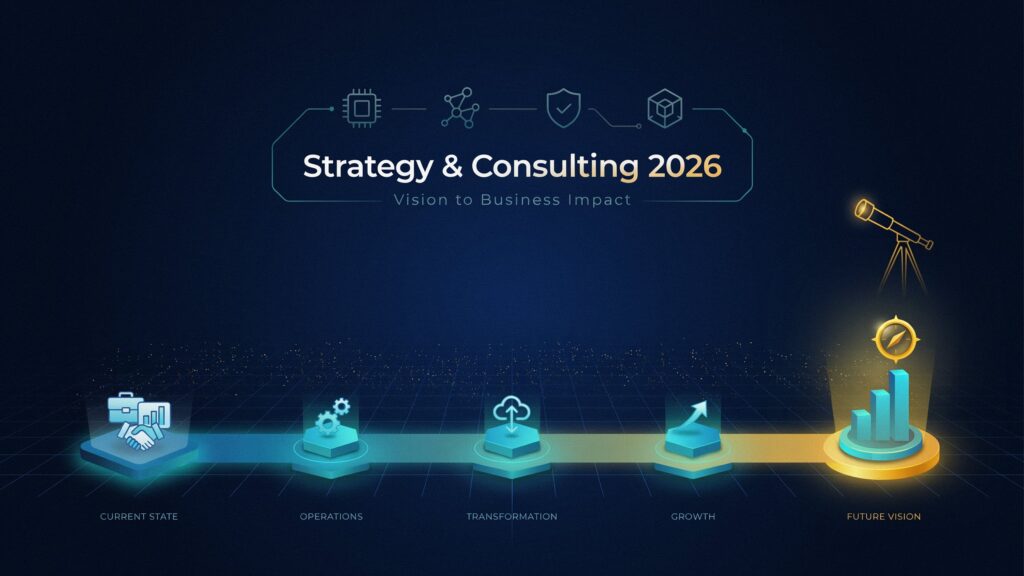
This comprehensive guide explains what effective strategy and consulting looks like in 2026, how to build a technology strategy that actually delivers results, and how to work with consultants (or build internal capability) to turn vision into measurable outcomes.
The New Reality of Strategy in 2026
Technology strategy today is fundamentally different from even five years ago:
- AI is no longer experimental — it’s a core part of operating models
- Business and technology strategy are inseparable
- Speed of execution often matters more than perfection of plan
- Uncertainty is the only constant (geopolitics, regulation, emerging tech)
- Sustainability, ethics, and responsible AI are now board-level concerns
The best strategies are no longer static 3–5 year plans. They are adaptive frameworks that guide decision-making in real time.
Why Most Technology Strategies Fail
Common reasons I see repeatedly:
- Too much focus on technology, not enough on business outcomes
- Lack of alignment between business leaders and technology teams
- Overly ambitious plans without realistic roadmaps or capabilities
- Ignoring organizational culture and change readiness
- Creating beautiful documents that gather dust
- Failing to build continuous strategy capabilities
The Modern Strategy and Consulting Framework for 2026
Here’s a practical, battle-tested approach that works across industries and company sizes:
Phase 1: Discovery & Alignment (4–6 weeks)
- Deep-dive stakeholder interviews across business and technology
- Assess current capabilities, pain points, and opportunities
- Analyze market trends, competitive landscape, and customer expectations
- Define clear business objectives (revenue growth, cost reduction, customer experience, etc.)
- Identify strategic themes and priorities
Key Output: Current State Assessment + Vision Alignment
Phase 2: Vision & Opportunity Framing (3–5 weeks)
- Co-create a compelling future-state vision
- Identify high-impact initiatives using a value vs. effort matrix
- Explore technology enablers (AI, cloud, data platforms, automation, etc.)
- Define success metrics and guardrails
- Build initial business cases for priority initiatives
Key Output: Strategic Vision + Prioritized Opportunity Map
Phase 3: Roadmap & Architecture Design (6–8 weeks)
- Develop a phased, realistic implementation roadmap
- Define target architecture and technology principles
- Create investment and resource plans
- Address risks, dependencies, and change impacts
- Design governance and measurement framework
Key Output: Executable Multi-Year Roadmap + Architecture Blueprint
Phase 4: Execution Planning & Capability Building (Ongoing)
- Break initiatives into actionable programs and projects
- Build or augment internal capabilities
- Establish agile governance and review cadences
- Plan for continuous learning and adaptation
Phase 5: Continuous Strategy & Adaptation
- Regular strategy reviews (quarterly)
- Horizon scanning for emerging technologies
- Feedback loops from execution back into strategy
- Annual deep-dive refresh
Key Elements of an Effective 2026 Technology Strategy
1. Business-Led, Technology-Enabled
The strategy must start with business outcomes, not cool technologies.
2. Portfolio Approach
Treat initiatives like an investment portfolio — balance quick wins, foundational work, and bold bets.
3. Adaptive Planning
Build in regular checkpoints to adjust based on results and new information.
4. People & Culture at the Center
Technology changes fail without addressing skills, mindset, and ways of working.
5. Measurable Value
Every major initiative should have clear KPIs tied to business performance.
6. Responsible Innovation
Incorporate ethics, sustainability, and risk management from the start.
How to Work Effectively with Strategy Consultants
Best practices:
- Choose partners with proven cross-industry (or deep vertical) experience
- Insist on collaborative workshops rather than “black box” deliverables
- Require knowledge transfer and internal capability building
- Use phased engagements with clear decision points
- Maintain strong internal ownership throughout
Red flags:
- Consultants who push their favorite technologies regardless of your needs
- Vague deliverables and success criteria
- Over-reliance on junior resources
- No clear plan for post-engagement support
Building Internal Strategy Capability
While external consultants provide valuable objectivity and specialized expertise, the strongest organizations eventually build internal strategy muscle. This includes:
- Dedicated strategy or enterprise architecture roles
- Regular cross-functional strategy forums
- Training programs for business and tech leaders
- Investment in tools for scenario planning and roadmapping
Real-World Global Examples
Global Retailer (Europe/US): Developed a unified commerce strategy that integrated online and physical channels. Resulted in 28% revenue uplift and significantly improved customer experience.
Manufacturing Conglomerate (Asia): Created a smart factory roadmap leveraging IoT, AI, and automation. Achieved 35%+ efficiency gains within 24 months.
Financial Services Firm (Middle East): Built a digital-first strategy that accelerated their cloud and AI adoption while maintaining strict regulatory compliance.
Final Thoughts
Strategy and consulting in 2026 are about much more than creating PowerPoint decks. They’re about creating clarity, alignment, and momentum in an increasingly complex world.
The best strategies are living documents — practical, actionable, and regularly refreshed. They balance ambition with realism, technology possibilities with business realities, and long-term vision with short-term execution.
Whether you work with external consultants or build everything internally, the principles remain the same:
- Start with the business, not the technology
- Be ruthless about prioritization
- Focus relentlessly on measurable outcomes
- Build adaptability into everything you do
- Never stop learning and evolving
If your organization feels stuck, reactive, or unsure about its technology direction, investing in proper strategy work is one of the highest-leverage moves you can make.
The future doesn’t belong to the companies with the most advanced technology. It belongs to those who use technology most strategically to create real, sustainable value.
Get your strategy right. Execute with discipline. Adapt continuously.
That combination is what separates industry leaders from everyone else in 2026 and beyond.