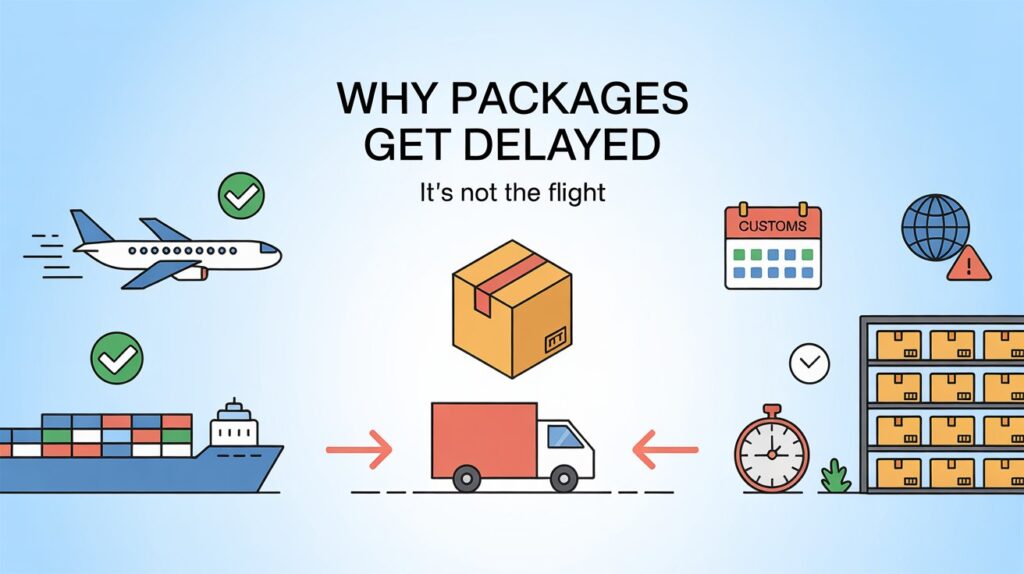
International shipping has never been faster—and that’s exactly why delays can feel so confusing. A package can leave a warehouse in China, cross an ocean, land in Europe or North America, and still take another week before reaching the customer. Many shoppers assume the longest part of the journey is the flight, but in reality, transportation is often the easiest step. The real delays usually happen after the package arrives. Modern logistics networks move millions of parcels every day, and keeping track of that volume has become one of the biggest challenges in global commerce.
Packages Are Arriving Faster Than Warehouses Can Process Them
One of the biggest surprises in international shipping is that transportation often isn’t the bottleneck anymore. Cargo planes, ships, and trucks have become extremely efficient, but sorting centers are dealing with record volumes of parcels. During busy periods, thousands of containers can arrive at a hub within hours. Every package must be unloaded, scanned, sorted, and routed to the next destination. If a facility receives more shipments than it can process, packages start waiting in queues. This creates the strange situation where a parcel can travel halfway around the world in two days and then sit in a warehouse for four or five more. For customers, it looks like nothing is happening. Behind the scenes, the package may simply be waiting its turn among tens of thousands of others.
Customs Is No Longer Just a Quick Stamp
Many people still imagine customs as a simple checkpoint where someone glances at a package and lets it continue. Today, the process is far more complex. Customs agencies are paying closer attention to product values, batteries, electronics, branded goods, and restricted items. Some packages are selected for additional review based on automated risk systems before a person ever touches the shipment. Even when everything is declared correctly, the parcel may spend extra time waiting for inspection simply because customs facilities are handling huge volumes of international orders. This is why one of the most frustrating tracking updates is “Arrived in destination country.” Customers think the package is almost at their door, while in reality it may still need several more steps before being released.
Why Cheap Shipping Often Takes the Longest
One of the least understood parts of international logistics is how economy shipping works. Many low-cost delivery options are designed around efficiency rather than speed. Instead of sending each package immediately, logistics companies often group large numbers of shipments moving to the same region. A package may be packed, labeled, and ready to go, but still wait several days until enough other parcels arrive to fill a container or cargo pallet. This helps keep shipping costs low, but it also explains why two customers can order the same item from the same store and receive it weeks apart. In many cases, the delay begins before the package even leaves the country of origin.
The Tracking Status That Confuses Everyone
If there is one tracking update that causes endless confusion, it is “In Transit.” To customers, it sounds like a package is actively moving toward them. In reality, that single status can hide dozens of different situations. The parcel might be waiting for a flight, sitting in a customs facility, being transferred between carriers, traveling by truck between sorting centers, or simply waiting for its next scan. Sometimes a package receives no updates for several days and then suddenly shows multiple new statuses at once. This doesn’t necessarily mean it was stuck. Many logistics systems upload tracking information in batches, meaning the package may have been moving the entire time.
One Package Can Have More Than One Tracking Number
Many shoppers don’t realize that international shipments sometimes change tracking numbers during the journey. This often happens when one logistics network hands a parcel to another company for the final delivery stage. The original tracking number may stop updating, while a new number takes over later in the process. To the customer, it can look as though the package disappeared. In reality, it simply changed systems. This is one reason why people occasionally think their order has been lost when it is actually moving normally. The package is still traveling, but the information is no longer appearing where they expect it.
Batteries Create More Delays Than Most People Realize
Small lithium batteries are hidden inside countless products people buy every day—wireless earbuds, smartwatches, power banks, gaming accessories, phones, and even some toys. Because damaged lithium batteries can pose fire risks during transportation, shipments containing them often require additional safety procedures. Airlines and logistics providers follow strict rules for handling these products, and certain routes may have extra restrictions. As a result, a tiny electronic gadget can sometimes take longer to arrive than a much larger package containing clothing or household items. Customers rarely see these checks in their tracking history, but they are happening behind the scenes.
Why Packages Sometimes Visit Countries You Never Ordered From
Tracking histories can occasionally look completely wrong. A package destined for France might appear in Belgium. A shipment going to Canada could pass through the United States. An order traveling to Eastern Europe might first stop in the Netherlands or Germany. This isn’t usually a mistake. Large logistics hubs act like connecting airports for parcels. Instead of flying directly between every pair of countries, packages move through major sorting centers where shipments from many regions are combined and redistributed. The route may look inefficient on a map, but it is often the fastest option available within the global logistics network.
What Customers Don’t See Behind the Tracking Screen
The most important thing to understand about international shipping is that many delays happen in places customers never see. Massive warehouses, customs facilities, airport cargo terminals, sorting hubs, and transfer centers process enormous numbers of packages every day. When tracking updates suddenly stop, it is easy to imagine a parcel sitting forgotten somewhere. In reality, it may be moving through several different logistics networks, waiting for customs clearance, or traveling between major distribution hubs. This is especially common with cross-border shipments from Asia, where shoppers often follow a Cainiao tracking number and wonder why updates seem to disappear for days. In many cases, the package is still moving normally—the tracking system simply hasn’t received a new scan yet. The tracking page only shows part of the journey, while countless processes continue behind the scenes. Understanding that hidden journey makes modern shipping far less mysterious and helps explain why even the fastest international deliveries can occasionally take longer than expected.