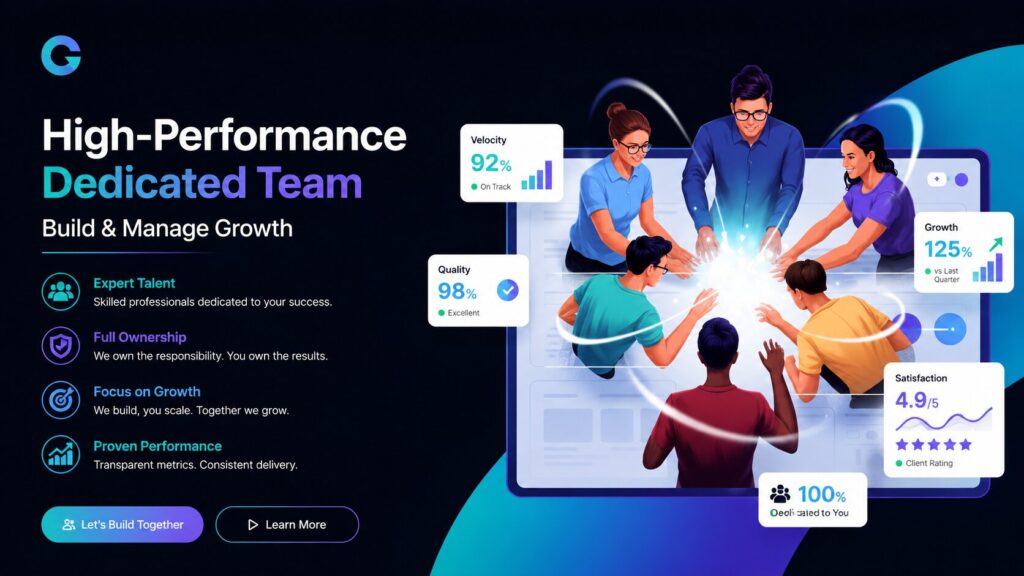
I’ve helped more than 30 companies worldwide set up dedicated development teams over the last four years. Some became extensions of their internal engineering organizations, delivering consistent velocity and deep product ownership. Others turned into expensive, low-output groups that created more management headaches than value.
The difference was never about talent quality or hourly rates. It was always about how deliberately the company built and managed the dedicated team.
In 2026, a well-run dedicated development team is one of the most powerful scaling tools available to growing companies and enterprises. It offers the stability of an in-house team with the flexibility and cost efficiency of outsourcing. This in-depth guide shares exactly how the most successful global organizations are doing it today.
What a True Dedicated Development Team Actually Means in 2026
A dedicated development team is a group of engineers, QA specialists, designers, and a project manager who work exclusively for your company on a long-term basis (typically 6–36 months or longer). They become a virtual extension of your product team, not just external contractors.
Key characteristics of high-performance dedicated teams:
- Full-time allocation (no sharing across clients)
- Deep domain and product knowledge over time
- Cultural and process alignment with your company
- Shared accountability for outcomes, not just output
- Transparent reporting and tooling integration
Why Dedicated Teams Outperform Other Models in Many Cases
Compared to Freelancers or Staff Augmentation:
- Much higher knowledge retention
- Better team cohesion and velocity
- Stronger alignment with your product vision
- Lower management overhead once mature
Compared to Fixed Price or Time & Material projects:
- Continuous delivery instead of project-by-project
- Ability to pivot quickly without renegotiating contracts
- Cumulative product intelligence that compounds over months
Global Data (2026):
- Companies using mature dedicated teams report 35–55% higher long-term productivity than traditional outsourcing models
- Retention rates of 88–94% are now common in top-tier partners
- Average ramp-up time to full productivity: 6–10 weeks (down from 3–4 months a few years ago)
When a Dedicated Development Team Is the Right Choice
Choose this model when:
- You need to build or scale a complex, long-term product
- You want to protect core intellectual property
- You plan to work with the same team for 12+ months
- You need consistent velocity and deep context
- Your internal team needs augmentation without losing control
It is usually not the best choice for one-off projects, very short engagements, or when you only need highly specialized skills for 2–3 months.
Step-by-Step: How to Build a High-Performance Dedicated Team
Phase 1: Strategic Preparation (4–6 weeks)
- Define clear goals and success metrics for the team
- Document your product vision, tech stack, and ways of working
- Decide on team size and composition (e.g., 6–8 developers + 1 QA + 1 PM is a common starting point)
- Choose the right geography mix (nearshore for overlap, offshore for scale)
Phase 2: Partner Selection
Look for partners who can demonstrate:
- Strong talent retention and low churn
- Experience with companies of your size and industry
- Mature processes for dedicated teams (not just project delivery)
- Transparent pricing and flexible contract terms
- Proven security and compliance standards
Phase 3: Team Formation & Onboarding (First 8–10 weeks)
- Involve your leadership in final candidate interviews
- Run a structured 4-week onboarding program (product deep-dive, tech sessions, shadowing)
- Set up shared tools from day one (Jira/Linear, Slack, GitHub, Notion, etc.)
- Establish communication cadences and escalation paths
Phase 4: High-Performance Operations
Daily/Weekly Practices:
- Daily stand-ups (15 minutes)
- Weekly sprint planning and demos
- Bi-weekly business reviews with your leadership
- Monthly OKR alignment sessions
Management Best Practices:
- Treat the team as “yours” — give them real ownership
- Invest in team-building and cultural integration
- Provide clear product roadmap visibility
- Celebrate wins together (both remote and in-person when possible)
Critical Success Factors in 2026
- Strong Product Ownership on Your Side: The single biggest predictor of success is having a capable Product Owner or Product Manager who works closely with the dedicated team.
- Modern Tooling & Transparency: Real-time dashboards, automated reporting, and shared observability tools eliminate “black box” feelings.
- Continuous Knowledge Transfer: Regular code reviews, architecture sessions, and documentation rituals ensure knowledge doesn’t stay only with the partner.
- Cultural Alignment: Time-zone overlap, English proficiency, and shared values matter more than ever.
- Performance-Based Incentives: Many successful partnerships now include team bonuses tied to business outcomes, not just hours worked.
Common Pitfalls That Destroy Dedicated Teams
- Treating the team as “outsourced labor” instead of partners
- Insufficient internal management and guidance
- Poor onboarding and lack of context
- Micromanagement or zero management
- Changing requirements too frequently without prioritization
- Ignoring team morale and burnout signals
Real Global Success Patterns
European SaaS Company → Built a dedicated team of 14 engineers in Poland. Achieved feature velocity 3x higher than their internal team while reducing total engineering cost by 48%.
North American HealthTech → Scaled from 4 to 22 engineers in a dedicated team in Latin America. Launched two major products in 14 months while maintaining strict HIPAA compliance.
Australian Fintech → Hybrid model (onshore Product + offshore Dedicated Team). Reduced time-to-market by 62% and improved code quality significantly.
Future of Dedicated Teams (2026–2028)
- AI pair-programming becoming standard within teams
- Smaller, higher-impact teams due to AI productivity gains
- Greater emphasis on “blended” onshore-offshore leadership
- More outcome-based commercial models (not just headcount)
Final Thoughts
A high-performance dedicated development team is not just another outsourcing arrangement — it is a strategic capability multiplier. When built and managed correctly, it gives you the best of both worlds: the focus and ownership of an in-house team combined with the speed, cost efficiency, and talent access of global outsourcing.
The companies winning in 2026 are not necessarily the ones with the biggest internal engineering organizations. They are the ones who know how to build and lead high-performing extended teams.
If you have a clear product vision, strong internal product leadership, and a need for sustained development capacity, a dedicated team may be one of the smartest investments you can make this year.
Take time to define what success looks like for your next major initiative. Then choose your partner and model with the same care you would use when hiring your own CTO or Head of Engineering.
The talent is out there. The frameworks exist. The only question is whether you will build the relationship and processes required to make it truly high-performance.