I’ve sat in boardrooms across North America, Europe, Asia, and the Middle East listening to CEOs and CTOs ask the same critical question: “What’s the smartest way to work with an external software development team?”
The answer has never been more nuanced than it is in 2026. The old “one-size-fits-all” approach is dead. Global economic uncertainty, AI-driven development speed, talent shortages, and rising regulatory requirements have made choosing the right collaboration model one of the highest-leverage decisions a business can make.
This in-depth guide compares the four major software development collaboration models — Fixed Price, Time & Material, Dedicated Team, and Staff Augmentation — with real 2026 data, global case studies, and a practical decision framework to help you choose the right one for your specific situation.
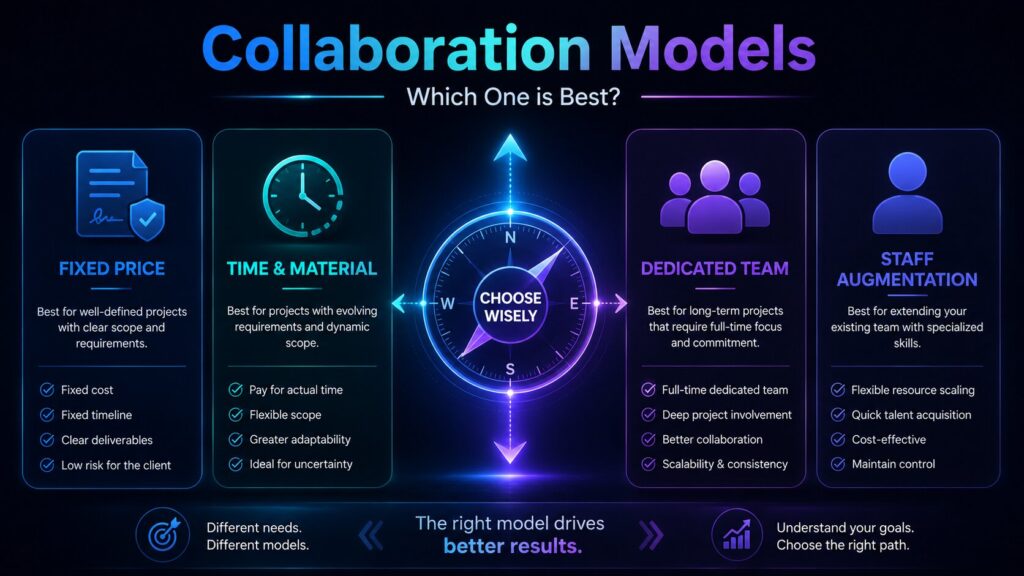
The Four Main Collaboration Models Explained
1. Fixed Price (FP)
You agree on a fixed scope, fixed price, and fixed timeline upfront.
Best for:
- Projects with very clear, well-defined requirements
- MVP development where scope is tightly controlled
- Government or highly regulated contracts
- Companies that need absolute budget certainty
Pros in 2026:
- Predictable cost and timeline
- Low vendor management overhead
- Strong incentive for the vendor to deliver efficiently
Cons:
- Expensive change requests (often 2–3x normal rate)
- Higher risk for the vendor → higher price buffer
- Less flexibility if business needs evolve
Global Pricing Reality (2026): Typical range: $45K–$250K+ depending on complexity. Best rates in Eastern Europe, Latin America, and Southeast Asia.
2. Time & Material (T&M)
You pay for actual time and resources used, usually billed monthly.
Best for:
- Projects with evolving or unclear requirements
- Long-term product development
- Startups and innovation initiatives
- When speed and flexibility matter more than fixed cost
Pros:
- High flexibility to pivot
- Pay only for what you actually use
- Faster start (no lengthy scoping phase)
- Transparent reporting
Cons:
- Less cost predictability
- Requires strong internal project oversight
- Potential for scope creep if not managed well
2026 Reality: Most popular model for mid-sized companies and ongoing development work.
3. Dedicated Team (DT)
You “rent” an entire team (developers, QA, PM, designer) that works exclusively for you, usually for 6+ months.
Best for:
- Long-term product development
- Companies that want to scale engineering capacity quickly
- When you need consistent velocity and deep product knowledge
- Building core intellectual property
Pros:
- Team becomes an extension of your company
- High knowledge retention
- Excellent velocity after ramp-up
- Cultural alignment possible
Cons:
- Higher monthly commitment
- Requires active management and leadership from your side
- Ramp-up time (1–2 months for full productivity)
2026 Global Advantage: Extremely popular with European and North American companies partnering with teams in India, Ukraine, Poland, Brazil, and Mexico.
4. Staff Augmentation
You add individual specialists (or small groups) directly to your existing team.
Best for:
- Filling specific skill gaps
- Temporary capacity boosts
- Companies with strong internal processes
- Short-to-medium term needs
Pros:
- Fastest ramp-up
- Full control over the resources
- Seamless integration with your existing team
- Lower long-term commitment
Cons:
- Less team cohesion than Dedicated model
- You bear more management responsibility
- Knowledge stays more with the individual than the vendor
2026 Comparison Table (Global Perspective)
| Model | Cost Predictability | Flexibility | Management Effort (from you) | Best Project Duration | Ideal Company Size | Average Monthly Cost (mid-level team) |
|---|---|---|---|---|---|---|
| Fixed Price | Very High | Low | Low | 2–6 months | Any | N/A (project-based) |
| Time & Material | Medium | Very High | Medium | Ongoing | Startups to Mid-size | $18K–$35K |
| Dedicated Team | Medium-High | High | Medium | 6+ months | Mid-size to Enterprise | $22K–$45K |
| Staff Augmentation | High | High | High | 3–12 months | Any with internal team | $8K–$18K per person |
Real Global Case Studies (2026)
Case 1: European Fintech Scale-up
Started with Fixed Price for MVP → switched to Dedicated Team after Series A. Result: Delivered core product 40% faster and raised Series B at 2.8x valuation.
Case 2: North American Enterprise
Used Staff Augmentation to add 12 senior engineers to their internal team during a major cloud migration. Completed the project 5 months ahead of schedule with zero knowledge loss.
Case 3: Australian SaaS Company
Chose Time & Material for a complete product redesign. High flexibility allowed three major pivots based on user feedback, resulting in 340% revenue growth in 14 months.
Case 4: Middle Eastern Government Project
Required Fixed Price + strict milestones due to regulatory and budget constraints. Successfully delivered on time and passed all audits.
Decision Framework: How to Choose the Right Model
Step 1: Answer These 6 Questions
- How clear and stable are your requirements?
- What is your internal management capacity?
- How important is speed vs cost certainty?
- How long do you expect the engagement to last?
- Do you need deep product knowledge retention?
- What is your risk tolerance?
Step 2: Match to Model
- Clear scope + fixed budget + regulatory needs → Fixed Price
- Evolving requirements + innovation focus → Time & Material
- Long-term product building + IP ownership → Dedicated Team
- Temporary skill gap + strong internal leadership → Staff Augmentation
Step 3: Consider Hybrid Approaches Many companies now use combinations (e.g., Dedicated Team for core product + Staff Augmentation for specialized skills).
Current Global Market Trends (2026)
- Dedicated Teams are growing fastest (especially in nearshore and offshore locations)
- Companies are demanding “blended teams” with both onshore and offshore talent
- AI tools are reducing team sizes needed for the same output
- Strong emphasis on cultural alignment and English proficiency
- Increased focus on data security and compliance in all models
Final Thoughts
There is no universally “best” collaboration model — only the best model for your current situation, goals, and internal capabilities.
The companies winning in 2026 are those that:
- Choose the model based on strategy, not convenience
- Re-evaluate their collaboration approach every 6–12 months
- Build genuine partnerships instead of transactional relationships
- Maintain strong internal ownership regardless of the model
Take 30 minutes this week to honestly assess your upcoming projects and internal capacity. The right collaboration model can literally save you hundreds of thousands of dollars while dramatically increasing your speed and quality.
The technology talent and tools are available globally. The real competitive advantage comes from choosing the smartest way to work with them.