Choosing the wrong project management methodology can make or break even the most promising initiatives. I’ve seen multimillion-dollar global projects succeed brilliantly with the right approach — and fail painfully with the wrong one.
In 2026, the debate is no longer simply “Agile vs Waterfall.” The reality is far more nuanced. Leading organizations worldwide are using sophisticated hybrid models that combine the best elements of multiple methodologies. This comprehensive guide will help you understand the strengths, weaknesses, and ideal use cases for each approach so you can make the right decision for your projects.
The Evolution of Project Management in 2026
The global business environment has become more volatile, uncertain, complex, and ambiguous (VUCA). Technology evolves rapidly, customer expectations shift constantly, and regulatory landscapes change frequently.
Traditional rigid methods often fail in this environment, while pure Agile can lack the structure needed for large-scale, highly regulated, or fixed-scope projects.
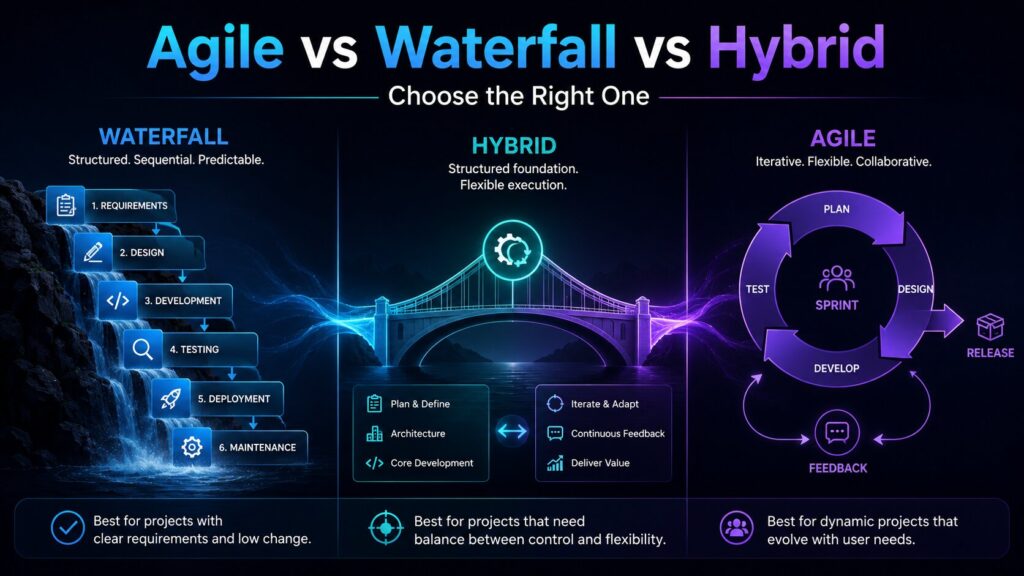
Detailed Comparison: Agile vs Waterfall vs Hybrid
| Criteria | Waterfall | Agile | Hybrid |
|---|---|---|---|
| Structure | Highly structured, sequential | Flexible, iterative | Balanced (structured + flexible) |
| Best For | Fixed requirements, regulated industries | Uncertain requirements, fast innovation | Most modern complex projects |
| Flexibility | Very Low | Very High | High |
| Risk Management | Front-loaded | Continuous | Balanced |
| Stakeholder Involvement | Mostly upfront | Continuous | Regular & structured |
| Delivery Speed | Slow (big bang) | Fast (incremental) | Medium to Fast |
| Budget Predictability | High | Low | Medium to High |
| Documentation | Heavy | Light | Balanced |
| Team Size | Works for both small & large | Best for small to medium | Scales well for large & distributed teams |
| Change Management | Difficult & expensive | Welcomed | Controlled & planned |
When to Choose Waterfall (2026 Perspective)
Despite its age, Waterfall is still the right choice in specific scenarios:
Best Use Cases:
- Construction, infrastructure, and engineering projects
- Highly regulated industries (aerospace, defense, pharmaceuticals, banking compliance)
- Projects with fixed scope, budget, and timeline (government contracts)
- Initiatives where requirements are very well understood upfront
- Hardware-heavy projects with long lead times
Advantages in 2026:
- Excellent predictability
- Strong documentation and audit trails
- Clear milestones and accountability
- Easier for traditional stakeholders and governance bodies
Modern Waterfall Adaptation: Many teams now add “Water-Scrum-Fall” — using Waterfall for planning and deployment phases while applying Scrum in the development phase.
When to Choose Agile
Agile remains the dominant methodology for software and digital projects globally.
Best Use Cases:
- Custom software development
- SaaS and digital product development
- Startups and innovation initiatives
- Projects with high uncertainty
- Environments requiring rapid feedback and iteration
Popular Agile Frameworks in 2026:
- Scrum (most widely used)
- Kanban (for support and maintenance)
- SAFe (Scaled Agile Framework) for enterprises
- Scrum@Scale and LeSS for large organizations
- Shape Up (Basecamp’s approach)
Key Success Factors:
- Strong product ownership
- Cross-functional teams
- Psychological safety and trust
- Disciplined backlog refinement
The Rise of Hybrid Methodologies (The Smart Choice for Most Organizations)
In 2026, Hybrid (or “Wagile”) approaches are used by approximately 60–70% of successful large-scale projects worldwide.
Popular Hybrid Models:
- Water-Scrum-Fall Waterfall for planning & requirements → Scrum for development → Waterfall for testing & deployment.
- Agile + Stage-Gate Agile delivery within structured governance gates.
- Scaled Agile with Traditional Elements SAFe combined with fixed milestones for executive reporting.
- Predictive + Adaptive Fixed high-level scope with flexible detailed execution.
Benefits of Hybrid:
- Combines predictability with flexibility
- Better suits distributed global teams
- Satisfies both innovation needs and governance requirements
- Easier adoption in traditional organizations
Decision Framework: How to Choose the Right Methodology
Ask These Key Questions:
- How clear are the requirements? → Very clear = Lean toward Waterfall/Hybrid → Uncertain = Lean toward Agile
- What is the level of regulatory compliance needed? → High = Waterfall or structured Hybrid
- How fast do you need to deliver value? → Very fast = Agile or Hybrid
- What is your organizational culture? → Traditional = Hybrid or Waterfall → Innovative = Agile
- Team size and distribution? → Large & distributed = Hybrid or SAFe
- Budget and contract type? → Fixed price = Waterfall or Hybrid → Time & Material = Agile
Global Implementation Best Practices
- North America & Western Europe: Strong preference for Hybrid and SAFe
- Asia-Pacific: Mix of Agile for tech projects and Waterfall for traditional sectors
- Middle East & Africa: Growing adoption of Hybrid due to infrastructure + digital projects
- Latin America: Increasing use of Agile in fintech and startups
Critical Success Factors Across All Methodologies:
- Strong sponsorship from leadership
- Proper training and change management
- Clear roles and responsibilities (especially Product Owner vs Project Manager)
- Robust tools (Jira, Azure DevOps, Monday.com, Linear)
- Regular retrospectives and continuous improvement
Real-World Global Case Studies
Case 1: Multinational Bank (Europe + Asia)
Used Hybrid (Water-Scrum-Fall) for a core banking transformation. Delivered on time, under budget, and passed all regulatory audits.
Case 2: E-commerce Giant (Global)
Switched from pure Waterfall to SAFe Agile. Reduced time-to-market by 65% and increased innovation output significantly.
Case 3: Government Digital Initiative (Middle East)
Implemented structured Hybrid approach. Achieved high transparency for stakeholders while maintaining development agility.
Final Thoughts: There Is No One-Size-Fits-All
In 2026, the most successful organizations don’t religiously follow one methodology. They thoughtfully select and adapt methodologies based on project type, organizational culture, regulatory environment, and strategic goals.
The winning formula is usually:
- Clarity + Flexibility — Structure where needed, agility where valuable
- Continuous Learning — Regular inspection and adaptation
- People First — Methodology serves the team, not the other way around
Take time to honestly assess your current and upcoming projects. Choose methodologies that align with your reality rather than following industry hype. When implemented thoughtfully, the right project management approach doesn’t just deliver projects — it becomes a genuine competitive advantage.
The future belongs to organizations that can balance discipline with adaptability. Choose wisely.