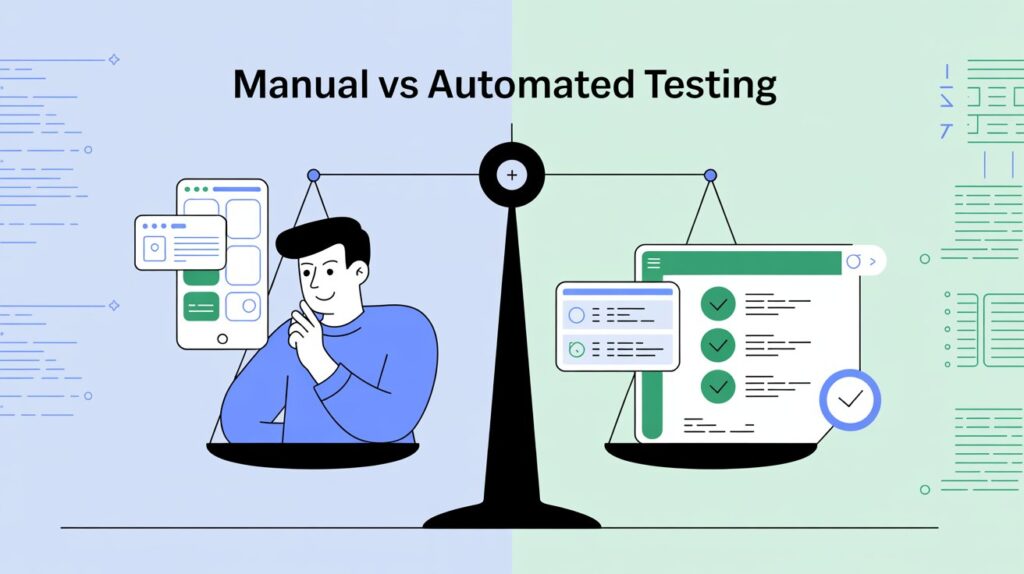
I’ve seen development teams waste hundreds of thousands of dollars and months of time by making the wrong choice between manual and automated testing. One team automated too much, ending up with a fragile test suite that took more time to maintain than it saved. Another relied almost entirely on manual testing and couldn’t release fast enough to stay competitive.
In 2026, the smartest teams don’t treat this as an either/or decision. They build a balanced, intelligent testing strategy that combines the strengths of both approaches.
This in-depth guide will help you understand exactly when to use manual testing, when to automate, how to create the optimal mix, and how leading software teams are doing it successfully today.
The Current Testing Landscape in 2026
Software is more complex than ever — microservices, AI features, multiple platforms, constant updates, and high user expectations. Testing is no longer just about finding bugs. It’s about delivering reliable, secure, and delightful experiences at speed.
Key Statistics (2026):
- Teams with mature automation release 3–5x faster
- Well-maintained automated suites reduce regression bugs by 70–85%
- Manual exploratory testing still catches 40–60% of critical usability and edge-case issues that automation misses
- The average company spends 25–35% of its development budget on testing
Manual Testing vs Automated Testing: Detailed Comparison
| Aspect | Manual Testing | Automated Testing |
|---|---|---|
| Speed | Slow | Very Fast (after initial setup) |
| Cost (Long-term) | High (repetitive work) | Lower after ROI is achieved |
| Exploratory Ability | Excellent | Limited |
| Repetitive Tasks | Poor | Excellent |
| Initial Setup Cost | Low | High |
| Maintenance | Low | High (if not done well) |
| Usability & UX Feedback | Very Strong | Weak |
| Edge Cases & Creativity | Excellent | Limited |
| Regression Testing | Weak | Very Strong |
| Best For | Exploration, usability, new features | Repetitive, critical paths, regression |
When to Use Manual Testing (And Why It’s Still Essential)
Manual testing remains irreplaceable in several scenarios:
Best Use Cases:
- Exploratory testing (discovering unexpected issues)
- Usability and user experience evaluation
- Accessibility testing (real human judgment)
- Ad-hoc testing of new features
- Visual and cross-device compatibility checks
- Security penetration testing (creative attacks)
- User acceptance testing (UAT)
Strengths:
- Human intuition and creativity
- Understanding context and user emotions
- Finding issues automation would never think of
When to Invest in Automated Testing
Best Use Cases:
- Repetitive regression testing
- Smoke and sanity tests
- API testing
- Performance and load testing
- Cross-browser and cross-device compatibility
- Data-driven testing
- Continuous Integration pipelines
High-ROI Automation Areas:
- Core user flows (login, checkout, onboarding)
- Critical business logic
- API contract testing
- Performance benchmarks
- Security regression scans
The Smart Strategy: Hybrid Testing Pyramid (2026 Version)
Modern successful teams follow a Testing Pyramid + Diamond approach:
- Base (Large): Unit + Integration tests (mostly automated)
- Middle: API + Component tests (heavily automated)
- Top (Small): End-to-End UI tests (selective automation)
- Diamond Layer: Manual exploratory + usability testing
Recommended Automation Coverage Goals:
- Unit Tests: 70–90%
- Integration/API Tests: 70–80%
- UI/E2E Tests: 20–40% (only critical paths)
- Manual Exploratory: Ongoing
Tools & Technologies in 2026
Automated Testing Stack:
- Web: Playwright (current leader), Cypress
- Mobile: Appium, Maestro, Detox
- API: Postman + Newman, RestAssured, Karate
- Performance: k6, Gatling, Artillery
- Visual Regression: Percy, Chromatic, Applitools
- AI-Powered: Testim, Mabl, Functionize
Manual Testing Support:
- TestRail or Xray for test case management
- Session recording tools (FullStory, Hotjar, LogRocket)
- Bug tracking (Jira, Linear)
How to Build an Effective Testing Strategy
Step-by-Step Framework:
- Risk Assessment Identify critical features, high-impact areas, and compliance requirements.
- Define Your Test Strategy Document What will be automated vs manual? Who owns what?
- Start Small & Smart Automate the most repetitive, high-value tests first.
- Implement Test Automation Early Best results come when automation starts in sprint 1.
- Maintain the Suite Religiously Flaky tests kill trust. Dedicate time every sprint for maintenance.
- Measure & Improve Continuously Track metrics like automation coverage, flakiness rate, and bug escape rate.
Common Mistakes Teams Still Make
- Trying to automate everything
- Writing automated tests too late
- Creating brittle, UI-dependent tests
- Neglecting manual exploratory testing
- Poor test data management
- No ownership of test maintenance
- Ignoring non-functional testing (performance, security)
Real-World Examples
Example 1: SaaS Company
Moved from 90% manual to 65% automated coverage. Release frequency increased from bi-weekly to daily. Production incidents dropped by 78%.
Example 2: E-commerce Platform
Kept strong manual exploratory team while automating checkout and payment flows. Black Friday sales went smoothly with zero critical issues.
Example 3: Fintech Startup
Heavy automation on regulatory workflows + deep manual security testing. Passed multiple compliance audits on first attempt.
Final Thoughts: The Balanced Approach Wins
In 2026, the most successful software teams don’t argue about manual vs automated testing. They master both and use each where it creates the most value.
The Golden Rule: Automate what is repetitive and critical. Manually test what requires human judgment, creativity, and empathy.
Quality is not the responsibility of just the QA team — it’s a shared engineering practice. When you combine disciplined automation with skilled human testing, you build software that is not only bug-free but also delightful to use.
Take an honest look at your current testing practices this week. Identify your biggest pain points and risks. Then create a practical 90-day plan to move toward a healthier, more balanced testing strategy.
The teams that get this right ship faster, with higher confidence, lower costs, and significantly better products. Your users — and your business metrics — will clearly show the difference.