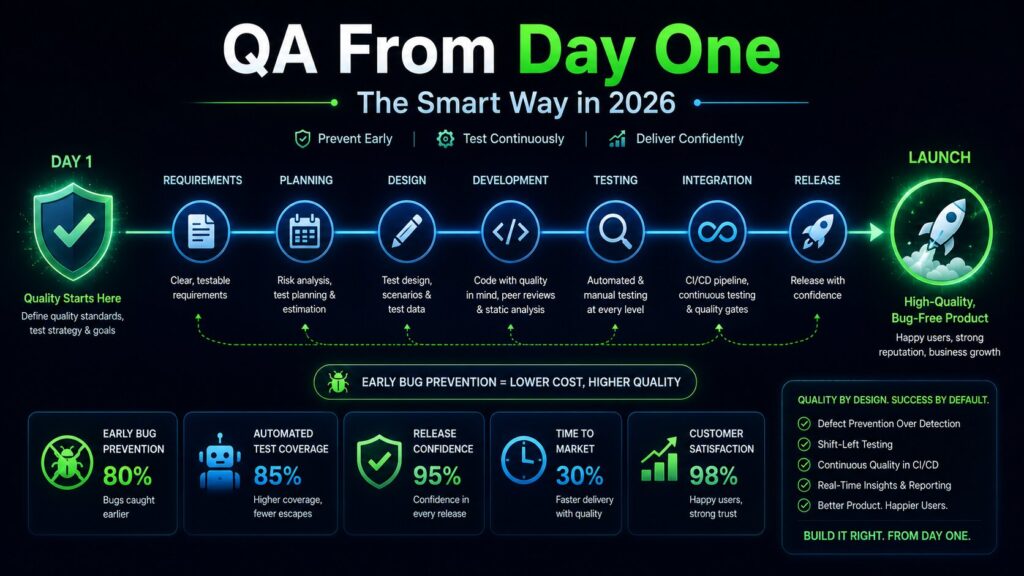
I’ve watched too many promising projects collapse in the final stages. A beautiful product built over 8 months suddenly reveals critical bugs, security vulnerabilities, and performance issues during launch week. The team scrambles, deadlines slip, costs skyrocket, and trust erodes.
In almost every case, the root cause was the same: Quality Assurance was treated as a final checkbox instead of a foundational part of the development process.
In 2026, with users expecting near-perfect experiences, stricter regulations, and fierce global competition, starting QA on day one is no longer optional — it’s a strategic necessity. This in-depth guide explains why, how to do it properly, modern QA practices that actually work, and the massive ROI you can expect.
The True Cost of Poor Quality Assurance
The numbers are sobering:
- The average cost of fixing a bug found in production is 100x higher than fixing it during development
- 60–70% of software projects still fail or significantly overrun due to quality issues
- Poor quality leads to 22–35% higher churn rates in SaaS products
- Security breaches caused by QA gaps cost companies an average of $4.88 million globally (IBM 2025 report)
One late-stage bug discovered after launch can destroy months of marketing momentum and user goodwill.
Why QA Must Begin on Day One
1. Quality is Designed, Not Tested In
The best QA happens when testers, developers, and product people collaborate from the requirements phase. This prevents building the wrong thing in the wrong way.
2. Shift-Left Testing Philosophy
“Shift-left” means moving testing activities as early as possible in the development lifecycle. In 2026, leading teams test requirements, designs, and code — not just the final product.
3. Faster Feedback Loops
Early QA means issues are caught within hours or days, not weeks or months. This dramatically accelerates development velocity.
4. Cost Efficiency
Finding and fixing defects early is exponentially cheaper.
5. Better Risk Management
Continuous quality practices surface security, performance, and compliance risks long before they become crises.
The Modern Quality Assurance Framework for 2026
Phase 1: Requirements & Design QA (Before Any Code)
- Review user stories for clarity and testability
- Create acceptance criteria using Gherkin (Given-When-Then)
- Design walkthroughs and usability reviews
- Risk analysis and prioritization
- Accessibility and compliance checks
Phase 2: Development-Time Testing
- Test-Driven Development (TDD) or Behavior-Driven Development (BDD)
- Unit testing with high coverage (>80% for critical code)
- Static code analysis (SonarQube, ESLint, etc.)
- Automated security scanning (SAST)
- Pair programming with QA mindset
Phase 3: Integration & System Testing
- Automated API testing (Postman, RestAssured, or Karate)
- Contract testing for microservices
- Performance and load testing early
- Cross-browser and cross-device testing
Phase 4: Continuous Testing in CI/CD
- Every code commit triggers automated test suites
- Parallel test execution for speed
- Test environments that mirror production
- Feature flag-based testing
Phase 5: Exploratory & User-Centric Testing
- Manual exploratory testing by skilled QA engineers
- Real-user beta testing
- Session recordings and heatmaps
- Accessibility audits (axe, WAVE, etc.)
Phase 6: Production Monitoring & Feedback
- Synthetic monitoring
- Real User Monitoring (RUM)
- Error tracking (Sentry, Datadog)
- Automated rollback capabilities
Essential QA Practices & Tools in 2026
Automation-First Approach
- Selenium, Playwright, or Cypress for UI
- Appium or Detox for mobile
- REST Assured / Pact for APIs
- k6 or Gatling for performance
AI-Powered Testing (Emerging Standard)
- AI test generation and maintenance
- Visual regression testing
- Anomaly detection in logs and metrics
- Predictive quality analytics
Security & Compliance Testing
- OWASP ZAP, Burp Suite
- Automated penetration testing
- Privacy impact assessments
- SOC 2 / ISO 27001 readiness
Performance Testing
- Load testing under realistic global traffic
- Stress testing
- Endurance testing
- Mobile network simulation
Building a Quality-First Culture
Key Elements:
- Quality is everyone’s responsibility (not just QA team)
- Celebrate bug prevention, not just bug finding
- Define clear quality gates in your CI/CD pipeline
- Regular blameless post-mortems
- Invest in training (developers learn testing, testers learn code)
Team Structures That Work:
- Embedded QA engineers in feature teams
- Center of Excellence for QA strategy
- Dedicated automation and performance specialists
Real-World Success Stories
Case Study 1: Fintech SaaS
Implemented shift-left + comprehensive automation. Reduced production bugs by 87%, shortened release cycles from 3 weeks to 4 days, and improved customer NPS by 41 points.
Case Study 2: E-commerce Platform
Early performance testing revealed critical scalability issues during Black Friday simulation. Fixed before launch, preventing a potential revenue disaster and saving millions.
Case Study 3: HealthTech App
Rigorous QA and compliance testing from day one helped them achieve HIPAA + GDPR compliance faster, accelerating enterprise sales by 6 months.
Common QA Mistakes That Still Kill Projects
- Treating QA as a separate late-stage phase
- Insufficient test data and environments
- Over-reliance on manual testing
- Ignoring non-functional requirements (performance, security, accessibility)
- Poor test maintenance (flaky tests)
- Lack of real-user testing
- Under-investing in QA talent and tools
Measuring QA Success & ROI
Key Metrics:
- Defect Escape Rate (bugs reaching production)
- Test Automation Coverage
- Mean Time to Detect/Repair
- Release Frequency & Stability
- Customer Satisfaction & Churn related to quality
- Cost of Quality (prevention + appraisal vs failure costs)
Expected ROI: Companies that implement modern QA practices from the start typically see:
- 40–60% reduction in post-launch defects
- 30–50% faster time to market
- 25–40% lower total development costs
- Significantly higher customer retention
How to Get Started Today
- Audit your current process — Where are quality issues appearing?
- Define your Quality Policy — What does “good enough” mean for your product?
- Introduce shift-left practices in your next sprint
- Automate high-value repetitive tests first
- Involve QA in sprint planning and story refinement
- Set up proper monitoring even in early stages
Final Thoughts
Quality Assurance is not about finding bugs — it’s about preventing them and delivering exceptional experiences that users trust and love.
In 2026, the margin for error is razor thin. Users have endless alternatives, and one major quality failure can permanently damage your reputation. The teams winning are those that bake quality into every stage of development, treat testing as a continuous activity, and view QA as a business enabler rather than a cost center.
Start QA on day one. Make quality everyone’s responsibility. Invest in the right processes, tools, and people. The result won’t just be fewer bugs — it will be faster delivery, happier customers, stronger retention, and significantly better business outcomes.
Your future users, your development team, and your bottom line will all thank you for it.