I once worked with a global manufacturing company that was drowning in emails, spreadsheets, and outdated systems. Their suppliers, distributors, employees, and clients all needed different information, but everything was scattered. Communication delays were costing them millions every year.
After building a custom web portal, they reduced operational friction dramatically. Supplier onboarding time dropped by 65%, internal teams saved over 20 hours per week, and client satisfaction scores rose sharply. The portal became the central nervous system of their business.
This story repeats itself across industries in 2026. Whether you’re a B2B company, enterprise, or growing startup, a well-designed custom web portal can transform how you operate, collaborate, and generate revenue.
This in-depth guide explains exactly when and why you need a custom web portal, what features actually matter, real-world use cases, and how to approach development for maximum ROI.
What Is a Modern Web Portal in 2026?
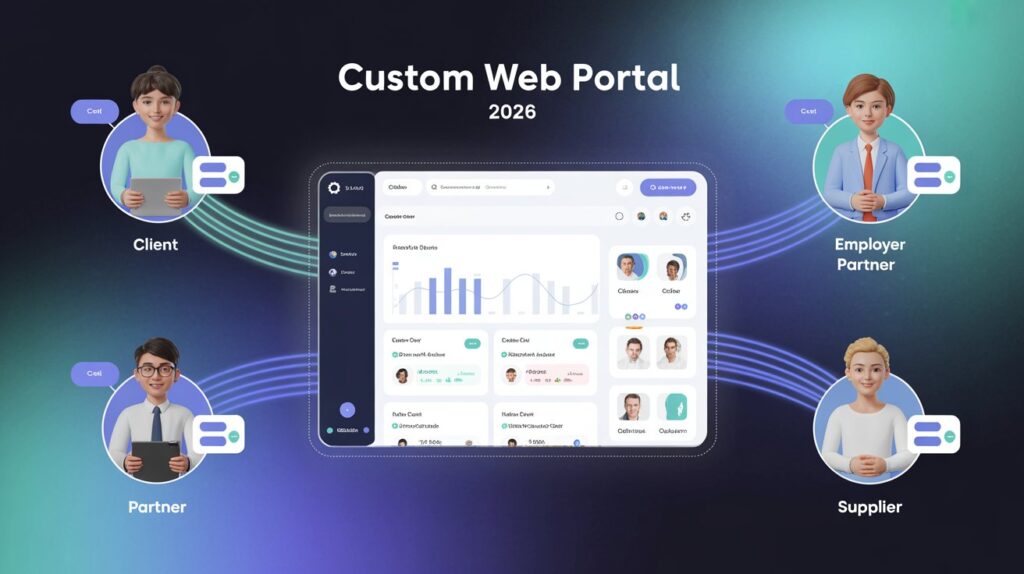
A web portal is a secure, centralized digital platform that gives different stakeholders (employees, clients, partners, vendors, etc.) tailored access to information, tools, and workflows.
Unlike a regular website or SaaS tool, a custom web portal is built specifically for your business processes, data, and ecosystem. It acts as a private hub that connects people and systems efficiently.
Key Types of Web Portals
- Employee / Internal Portals (Intranet 2.0)
- Client / Customer Portals
- Partner / Distributor Portals
- Supplier / Vendor Portals
- Investor / Board Portals
- Community / Membership Portals
Many companies combine several of these into one powerful platform with role-based access control.
Why Custom Web Portals Deliver Massive ROI in 2026
1. Operational Efficiency & Cost Savings
- Automate repetitive manual processes
- Reduce email back-and-forth by 70–80%
- Enable self-service for routine requests
- Centralize knowledge and documents
Real example: A logistics company replaced multiple tools with one supplier portal. They saved $380,000 annually in administrative costs within the first year.
2. Better Collaboration & Transparency
- Real-time project tracking
- Shared dashboards and analytics
- Secure document sharing with version control
- Integrated communication tools
3. Stronger Client & Partner Relationships
- 24/7 self-service access to invoices, reports, and support
- Personalized experiences
- Faster issue resolution
- Higher retention and upsell opportunities
4. Data Security & Compliance
- Granular permissions and audit logs
- SOC 2, ISO 27001, GDPR-ready architecture
- Full control over where your data lives (unlike third-party tools)
5. Competitive Advantage
While your competitors use generic tools, you deliver a branded, seamless experience that feels premium and tailored.
Must-Have Features for a High-Impact Web Portal in 2026
Core Foundation Features:
- Secure authentication (SSO, MFA, social login)
- Role-Based Access Control (RBAC) + granular permissions
- Responsive design (works perfectly on desktop & mobile)
- Advanced search across all data
- Activity feed and notifications
- Audit logs and compliance reporting
High-Value Functional Features:
- Custom dashboards with real-time analytics
- Document management with e-signature
- Workflow automation & approval engines
- Integrated messaging and video calls
- API integrations with your existing systems (CRM, ERP, accounting, etc.)
- Self-service ticketing and support
- Billing & invoicing module
- AI-powered insights and recommendations
Advanced 2026 Features:
- Command palette (⌘K style navigation)
- Dark mode + accessibility compliance
- White-label / multi-brand support
- Offline capabilities (Progressive Web App)
- Embedded analytics and reporting builder
Real-World Use Cases & Success Stories
Case 1: Client Portal for Professional Services Firm A consulting company built a client portal where clients could:
- Access project deliverables in real time
- Track budgets and timelines
- Submit feedback directly
- Download reports and invoices
Result: Client satisfaction increased 52%, project delays decreased 41%, and they won 3x more repeat business.
Case 2: Supplier Portal for Manufacturing A mid-sized manufacturer created a portal for 400+ global suppliers. Features included:
- Purchase order management
- Quality compliance submissions
- Payment status tracking
- Forecast sharing
Result: Supply chain visibility improved dramatically, lead time reduced by 28%, and relationship scores rose significantly.
Case 3: Employee Portal for a Distributed Team A remote-first software company replaced Slack + Google Drive + 7 other tools with one internal portal. Adoption reached 94% within two months, and knowledge-sharing efficiency improved measurably.
Technical Considerations for Building a Scalable Web Portal
Recommended Modern Stack (2026):
- Frontend: Next.js 15 + TypeScript + Tailwind
- Backend: NestJS or Laravel (depending on team expertise)
- Database: PostgreSQL
- Authentication: Clerk or NextAuth + enterprise SSO
- File Storage: AWS S3 or Cloudflare R2
- Real-time: Socket.io or Supabase Realtime
- Hosting: Vercel + AWS / Azure for backend
Key Architecture Principles:
- Multi-tenant design if serving multiple clients
- Micro-frontends for large portals (easier maintenance)
- Event-driven architecture for workflows
- Strong emphasis on security and data isolation
Development Approach & Timeline
Recommended Phases:
- Discovery & Requirements (3–4 weeks)
- Design & Prototyping (4–5 weeks)
- Core Development (10–16 weeks)
- Integrations & Testing (4–6 weeks)
- Launch & Training (2–3 weeks)
- Post-launch Iteration
Investment Range (Global Rates):
- Basic portal: $35K – $75K
- Mid-complexity (with multiple user types): $80K – $150K
- Enterprise-grade (heavy integrations, AI, compliance): $180K – $350K+
Common Pitfalls to Avoid
- Trying to build “everything” in version 1
- Underestimating integration complexity
- Poor user experience (this kills adoption)
- Weak security architecture
- Not planning for scalability early
- Choosing the wrong development partner
How to Measure Success
Key Metrics:
- User adoption rate (>70% within 3 months is excellent)
- Time saved per user per week
- Reduction in support tickets
- Increase in client/partner satisfaction (NPS)
- ROI calculation (usually 3–8x within 12–18 months)
When You Should Invest in a Custom Web Portal
You likely need one if:
- You manage relationships with many external parties
- Your team wastes time searching for information
- Clients/partners frequently ask for the same documents
- You have complex approval workflows
- Data security and branding matter significantly
- You want to differentiate from competitors
Final Thoughts
In 2026, businesses that thrive are the ones that remove friction from their operations and deliver exceptional digital experiences to every stakeholder.
A custom web portal isn’t just another software project. It’s a strategic investment in operational excellence, relationship building, and long-term competitive advantage.
Done right, it becomes the hub where your ecosystem lives — increasing efficiency, transparency, trust, and ultimately, revenue.
If your business is still relying on email threads, shared drives, and disconnected tools, you’re operating at a disadvantage. The technology and methodologies exist today to build something far better.
The question isn’t whether you can afford a custom web portal. The real question is: Can you afford not to have one?
Start by mapping your current pain points and stakeholder needs. That single exercise often reveals exactly where the biggest opportunities lie.
Your future self — and everyone who interacts with your business — will thank you for building it.