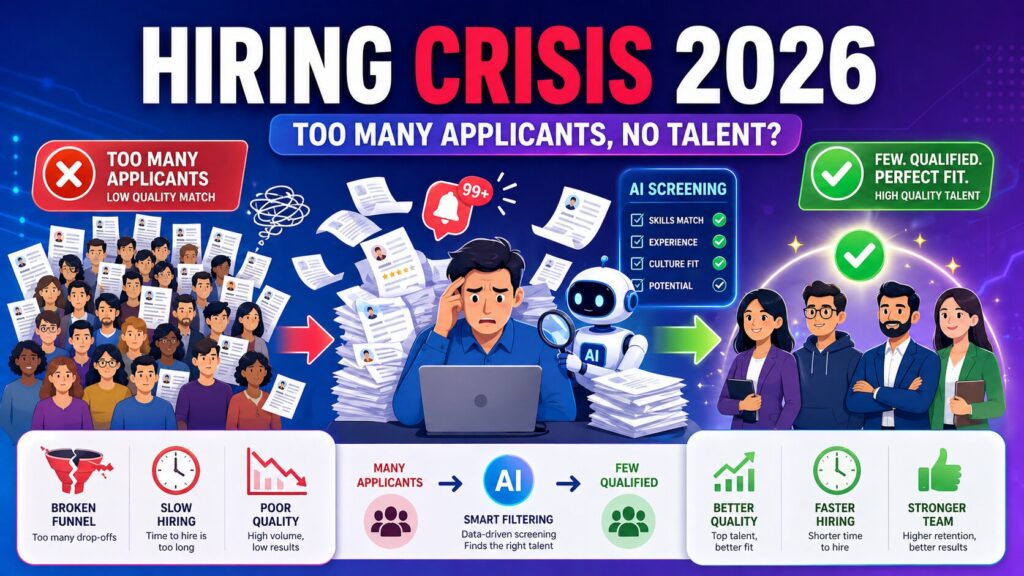
Picture this: A mid-sized SaaS company in Bangalore posts a straightforward “AI Engineer” role on LinkedIn and Naukri. Within 48 hours, they get 1,200 applications. Sounds like a dream, right? They end up hiring… nobody. The resumes looked impressive on paper, but almost none had the actual hands-on experience the team needed. This isn’t a one-off story — it’s happening every single day in 2026.
The Indian job market right now is full of these contradictions. Companies have strong hiring plans — India’s net employment outlook is one of the strongest globally, with many sectors planning double-digit growth. Yet 82% of Indian employers say they’re struggling to find the talent they actually need, according to ManpowerGroup’s 2026 Global Talent Shortage Survey. That’s higher than the global average of 72%.
Hiring in 2026 isn’t just harder. It’s fundamentally different. AI is reshaping everything, candidates have more choices than ever, and the old “post and pray” approach is dead. The companies that are winning aren’t the ones with the biggest budgets — they’re the ones treating hiring as a strategic business process instead of a reactive HR task.
In this article, we’ll break down the seven biggest hiring challenges businesses are facing right now and, more importantly, share practical, battle-tested ways to overcome them. Whether you’re an HR leader, a founder, or a hiring manager, these insights will help you stop wasting time and start building the team you actually need.
The New Reality of Hiring in 2026
India is in a strange spot. We have millions of graduates entering the workforce every year, yet companies keep complaining they can’t find the right people. The reason? A massive skills mismatch. AI, cybersecurity, data analytics, and cloud skills are exploding in demand, but the supply of people who can actually deliver isn’t keeping up.
At the same time, hiring intent is strong. Reports show 73% of employers planning to bring in freshers in the first half of 2026, and non-IT sectors like hospitality, BPO, and real estate are driving a lot of the growth. But volume alone doesn’t solve the problem. Freshers often lack real-world experience, mid-career talent is being poached aggressively, and AI tools have made it ridiculously easy for candidates to spam applications — many of them generated or heavily polished by ChatGPT.
The result? Application overload on one side and a drought of qualified candidates on the other. This is the new normal.
The Top 7 Real Hiring Challenges in 2026
Here’s what’s actually keeping hiring managers up at night — and exactly how smart companies are fighting back.
1. Severe Skills Gap & Mismatch
This is still the biggest headache. AI capabilities have now overtaken traditional IT and engineering skills as the hardest to find. Companies need people who understand generative AI, machine learning models, cybersecurity, and data — not just theory, but practical application.
Fresh graduates have degrees, but many lack the internship or project experience that actually matters. Mid-senior talent is even scarcer because everyone is fighting for the same experienced people.
How to overcome it: Shift to skills-based hiring instead of degree-based. Use practical assessments, take-home projects, or platforms like HackerRank. Build partnerships with bootcamps and universities for pipelines of pre-vetted talent. And most importantly, invest in upskilling your existing team — internal talent development is often faster and cheaper than external hiring.
2. Application Overload vs Quality Drought
Thanks to AI, candidates can now apply to dozens of jobs in minutes. Recruiters are drowning in irrelevant applications, many of them AI-generated. Generic roles get flooded, while niche senior positions sit empty for months.
How to overcome it: Write sharper, more specific job descriptions that scare away the wrong people. Use AI tools for the first round of screening, but always keep a human in the loop. Focus your sourcing on targeted platforms — LinkedIn for senior roles, Naukri for volume, and niche communities for specialists. Stop relying solely on “post and pray.”
3. High Candidate Expectations & Offer Rejections
Even when you find good people, they’re getting multiple offers. Salary expectations have shot up in competitive sectors, and candidates now care as much about flexibility, growth, and culture as they do about money. Ghosting after offers is common.
How to overcome it: Be transparent about salary ranges right from the start. Sell the full picture — career progression, learning opportunities, and work-life balance — not just the paycheck. Build a strong employer brand through employee stories and Glassdoor reviews. Move fast: the best candidates won’t wait three weeks for your offer.
4. Prolonged Time-to-Hire
Too many interview rounds, slow feedback from hiring managers, and multiple approval layers. What used to take 3–4 weeks now drags on for 6–10 weeks for mid-senior roles. Good candidates lose interest or accept other offers in the meantime.
How to overcome it: Set clear timelines and hold hiring managers accountable. Use structured interview scorecards so decisions happen faster. Limit interview rounds to 3–4 maximum for most roles. Create a “hiring sprint” mindset where the entire process is owned end-to-end.
5. Poor Candidate Experience
Long silences after interviews, generic rejection emails, or clunky application processes. In 2026, candidates talk — and a bad experience can damage your brand more than you think.
How to overcome it: Automate communication without losing the human touch. Send updates even when you’re rejecting someone. Respect their time — no more 10-round interviews or last-minute reschedules. Treat every candidate like a potential future employee or customer.
6. Diversity, Equity & Inclusion Challenges
Bias still creeps into sourcing and interviews. Many companies struggle to build diverse teams, especially in tech and leadership roles, even though the business case for it is stronger than ever.
How to overcome it: Use blind screening tools that hide names and photos during initial reviews. Build diverse interview panels. Rewrite job descriptions to use inclusive language. Partner with organisations that focus on women, LGBTQ+, and differently-abled talent pools.
7. Retention Risk Even Before Day One
You finally close a great candidate, they join… and leave within three to six months. The “boomerang hire” or quiet quitting phenomenon is real, especially among younger talent who quickly realise the job wasn’t what they expected.
How to overcome it: Give realistic job previews during the hiring process. Strengthen onboarding with clear 30-60-90 day plans and regular check-ins. Focus on culture fit, not just skills fit. The best retention strategy starts before the offer letter is signed.
Technology & Tools: What’s Actually Working in 2026
AI is everywhere in hiring now — from resume screening to interview scheduling and even predictive analytics. It’s helping with volume, but it’s not a magic fix. Over-relying on it can make your process feel cold and impersonal.
The companies doing it right use AI for the boring stuff (initial filtering, scheduling) and keep humans for the important parts (final interviews, cultural assessment). Popular tools in India include Naukri, LinkedIn Recruiter, Keka, and assessment platforms like HackerRank or CodeSignal.
The golden rule: Technology should support your process, not replace judgment.
Building a Future-Proof Hiring Strategy
Stop thinking of hiring as “filling vacancies.” Start treating it as building a talent pipeline. Great companies invest in employer branding year-round, not just when they have openings. They track metrics like quality of hire, source effectiveness, and time-to-productivity — not just time-to-hire.
Cross-functional collaboration is key. HR, hiring managers, and leadership need to sit together and own the process. Data-driven decisions beat gut feel every time.
Actionable Framework: The 5-Step Hiring Excellence Model
Here’s a simple framework you can start using tomorrow:
- Define Success Clearly — Write down exact skills, experience, and cultural traits needed (not just a generic JD).
- Attract the Right Pool — Use targeted sourcing, strong employer branding, and skills-first language.
- Assess Fairly and Thoroughly — Combine practical tests, structured interviews, and reference checks.
- Close with Confidence — Move fast, be transparent, and make the candidate feel wanted.
- Onboard for Long-Term Success — Set them up to win from day one with clear expectations and support.
Looking Ahead
Hiring challenges in 2026 are real — there’s no point pretending otherwise. But they’re also solvable. The companies that treat talent acquisition as a core business capability, not just an HR checkbox, are the ones pulling ahead.
They’re the ones who’ve moved from reactive hiring to strategic talent building. They invest in skills, speed, and candidate experience. And they understand that in today’s market, the best people have choices — so you have to earn them.
If you audit your current process against these seven challenges and start implementing even a few of the practical fixes above, you’ll already be ahead of most organisations.
The talent war isn’t going away. But the winners aren’t the ones complaining about it — they’re the ones who’ve figured out how to win anyway.
What’s one hiring challenge you’re facing right now? Drop it in the comments — I’d love to hear what’s actually happening on the ground in your industry.