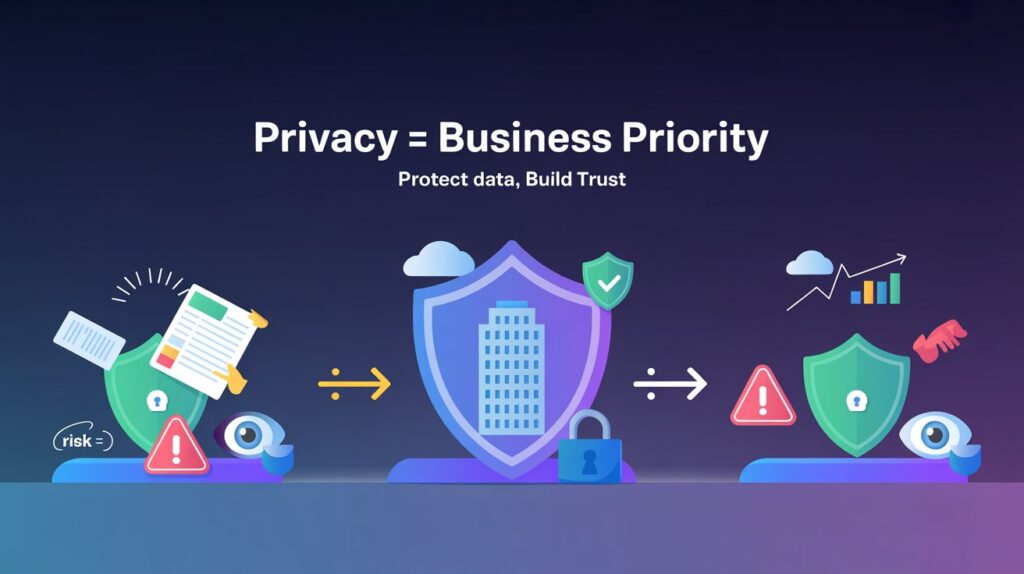
Privacy used to sit in the “IT and legal” corner—important, sure, but rarely a boardroom headline unless something went wrong. That’s changed. Today, privacy protection is increasingly treated like a core business capability, alongside finance controls, supply chain resilience, and cyber security. And it’s not just because regulators are watching more closely (though they are). It’s because privacy failures now create fast, expensive, very public consequences.
If you run a business—or advise one—you’ve likely felt the shift. Clients ask tougher questions in procurement. Partners want assurance around data handling. Employees expect boundaries. Meanwhile, the ways companies can lose sensitive information have multiplied: cloud collaboration, remote work, always-on devices, smart offices, and a growing ecosystem of vendors that touch your data.
So why exactly is privacy protection rising to the top? Let’s unpack what’s driving the change and what “good” looks like in practice.
Privacy Is Now a Trust Issue, Not Just a Compliance Issue
Regulation matters, but trust is the real accelerant. Customers and business buyers have become more selective about who they share information with, and they have more visibility than ever into how companies behave. One high-profile incident—an exposed database, an employee recording, a leaked negotiation—can undo years of reputation-building.
In B2B especially, privacy is increasingly embedded into deal-making. It shows up as security questionnaires, data processing agreements, audit rights, and strict vendor requirements. If you can’t demonstrate credible controls, you may not even make it past procurement. That’s not “nice to have” territory; it’s revenue.
There’s also an internal dimension: employees expect workplaces to respect personal data and communications. When that expectation is violated—through overly invasive monitoring, careless handling of HR data, or poor access controls—morale and retention suffer.
The reputational cost is compounding
A decade ago, a privacy incident might have been localized: a handful of customers, a small news story, a quick patch. Now it’s different. Social media, breach notification obligations, and heightened public awareness mean events travel faster and linger longer. You’re not just fixing a technical issue; you’re managing perception, legal exposure, and customer churn simultaneously.
The Threat Landscape Has Expanded Beyond “Hackers”
Most leaders understand the cyber side of risk—phishing, ransomware, credential stuffing. What’s sometimes missed is how privacy risk also emerges from the physical world and from everyday business operations.
Remote and hybrid work has blurred the perimeter. Sensitive conversations happen in co-working spaces, taxis, hotel lobbies, and home offices. Board packs get printed. Laptops get left in cars. Audio can be captured in more ways than people realize, including through compromised devices or insecure meeting setups.
And then there’s corporate intelligence gathering—sometimes legitimate (competitive research), sometimes not. High-stakes industries like finance, construction tendering, legal services, tech, and property can attract adversaries who aren’t looking to “hack” a firewall; they’re looking to obtain leverage. That can mean eavesdropping on negotiation strategy, learning pricing models, uncovering IP details, or tracking internal decision-making.
Around this point, many firms broaden their approach from purely digital security to a wider privacy posture that includes the environment in which sensitive work happens. If that’s a concern in your context, it may be worth exploring how professionals assess exposure; you can learn more about counter surveillance and what a technical sweep actually involves. The key is recognizing that privacy risk can be physical, behavioral, and procedural—not only technical.
“Insiders” aren’t always malicious—just careless
A large share of privacy incidents stem from ordinary mistakes: misaddressed emails, overshared files, poor permissioning, or employees using personal apps because they’re convenient. That’s not an argument for heavy-handed monitoring; it’s a reminder that privacy protection has to be designed into workflows, not bolted on via policy documents no one reads.
Data Is Moving Faster Than Governance Can Keep Up
Businesses collect more data than ever: analytics, recordings, support tickets, chat logs, biometrics, location data, and behavioral signals from connected devices. AI tools add another layer, because they can ingest and transform information quickly—and sometimes opaquely.
The result is a common pattern: data flows grow organically while governance lags behind. Teams spin up new SaaS tools, integrate vendors, or experiment with AI assistants, and suddenly sensitive information sits in places the organization didn’t anticipate.
AI is raising the stakes (and the questions)
AI doesn’t automatically create privacy risk, but it amplifies it in a few ways:
- It can make re-identification easier, even from “anonymized” datasets.
- It encourages broader data sharing to “improve output,” often without clear boundaries.
- It introduces uncertainty about where data is processed, stored, or retained—especially with third-party models.
The practical implication: privacy programs now need to engage product, data, and operations teams—not only IT and legal. If privacy is treated as a last-minute compliance check, it will consistently fall behind the pace of change.
What Strong Privacy Protection Looks Like in 2026
The best programs are pragmatic. They focus on reducing meaningful risk rather than chasing perfection. They also recognize that privacy is both a systems problem and a human problem.
Build a privacy posture that works day-to-day
Here are high-impact moves that tend to deliver results without creating bureaucracy (one set of bullets, because nobody needs a 40-point checklist):
- Map your “sensitive moments,” not just your sensitive data. Identify when confidentiality matters most: pricing discussions, M&A, HR investigations, product roadmaps, contract negotiations.
- Minimize by default. Collect less, retain less, and restrict access more. This is still one of the strongest defenses against both breaches and internal leaks.
- Treat vendors like part of your perimeter. Know which tools touch sensitive data, what they retain, and how quickly you can offboard if needed.
- Harden meeting and collaboration practices. Clear rules around recording, transcription, guest access, and document sharing prevent a surprising number of incidents.
- Train for realism. Short, scenario-based training beats annual slide decks. People remember “what to do” when the scenario resembles their actual work.
Measure what matters
If privacy is a priority, it needs metrics that leaders can act on. Useful indicators include: access review completion rates, time to revoke access for leavers, number of uncontrolled data repositories, vendor risk status, and incident response times. The goal isn’t to produce vanity dashboards; it’s to spot drift early—before it becomes a headline.
The Bottom Line: Privacy Is Becoming a Competitive Advantage
Privacy protection is rising because the cost of getting it wrong is higher, the pathways to exposure are broader, and stakeholders are less forgiving. But there’s a more positive angle, too: businesses that handle sensitive information responsibly win trust faster and operate with fewer surprises.
If you’re deciding where to invest next, don’t frame privacy as a defensive “tax.” Treat it as part of how you run a modern organization: clear boundaries, strong controls, and practical habits that protect customers, employees, and the business itself. That’s what resilient companies are building now—and it’s why privacy has become a priority rather than a footnote.