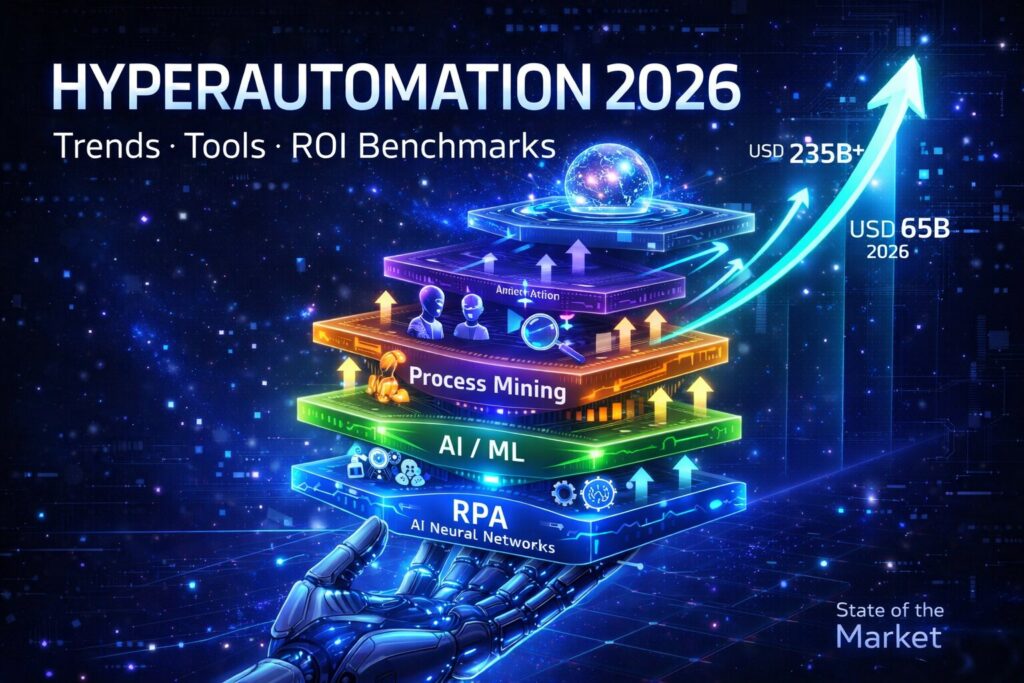
If you’re looking at automation in 2026, you’re no longer asking “Should we do this?”—you’re asking “How far and how fast can we go without breaking things?”
Research firms estimate the global hyperautomation market at around 65–70 billion USD in 2025, with projections of roughly 280–300 billion USD by 2035, at about 16–19 percent annual growth. At the same time, Gartner-linked reports say about 90 percent of large enterprises now treat hyperautomation as a top priority, and by 2026 roughly 30 percent of enterprises are expected to automate more than half of their network activities, up from under 10 percent in 2023.
Behind these numbers is a clear shift. Early automation programs were mostly RPA pilots—bots copying what humans did on screens in finance or HR. Now, in 2026, you see full hyperautomation ecosystems: RPA bots, AI and generative AI models, process mining, low-code apps, intelligent document processing, and orchestration layers that act like a digital control tower for work.
Why is 2026 such a turning point?
-
Companies are moving from isolated pilots to enterprise-scale rollouts across multiple functions.
-
Cognitive orchestration is emerging—AI systems that route work, handle exceptions, and coordinate bots and people in real time.
-
Process mining and digital twins are making operations more predictive and self-optimizing, not just automated.
When hyperautomation is done well, you see numbers like these:
-
Around 20–40 percent reduction in operating costs in targeted areas.
-
Roughly 40 percent faster process execution in many implementations.
-
Payback in 6–12 months for high‑volume use cases like invoice processing or claims.
But there is also a warning sign: fewer than 20 percent of large enterprises say they have really mastered measurement and governance for these initiatives. In other words, most companies are pushing hard on automation, but many still can’t clearly prove what is working and what is not.
In this article you’ll get:
-
A clear picture of what hyperautomation really means in 2026.
-
A market overview with realistic growth numbers.
-
The top trends you need to understand (cognitive orchestration, digital twins, low-code, GenAI, governance, ESG, and more).
-
A breakdown of leading tools and platforms, with simple guidance on where each fits.
-
Real ROI benchmarks and cross‑industry case patterns so you can set expectations inside your company.
-
A step‑by‑step framework to build or update your 2026 hyperautomation strategy.
Any numbers you see here come from analyst reports, vendor documentation, or practitioner case studies, not guesswork. Use them as directional benchmarks, not rigid promises.
What is hyperautomation in 2026?
From simple bots to orchestrated digital workforces
Think of the evolution like this:
-
RPA (Robotic Process Automation)
-
Goal: automate repetitive, rules-based tasks.
-
Bots mimic humans—clicking buttons, copying data between systems.
-
Great for things like invoice entry, report downloads, simple data updates.
-
-
Intelligent automation
-
RPA + AI / ML / NLP to handle unstructured data (emails, PDFs, images) and basic decisions.
-
Bots can read documents, classify requests, and handle more complex steps.
-
-
Hyperautomation (2026 view)
-
An end‑to‑end approach that uses many tools together: RPA, AI/ML, generative AI, process mining, task mining, low‑code, IDP, and orchestration.
-
Focus shifts from “automate this task” to “automate, connect, and continuously improve this whole process or journey.”
-
In 2026, hyperautomation is not just about bots. It is about building a digital workforce that works alongside your people, runs across your tech stack, and learns from data over time.
The core building blocks
Most serious hyperautomation setups today include:
-
RPA bots – Software robots that handle structured, repetitive tasks across UI and APIs at scale.
-
AI, ML, and GenAI (agentic AI) –
Models that:-
classify documents and messages
-
extract data and understand language
-
make predictions and recommendations
-
generate content (emails, summaries, code snippets)
You’ll also hear “agentic AI”: small goal‑driven agents that can plan and act within guardrails.
-
-
Process mining and task mining –
Tools that:-
read event logs from systems like ERP/CRM to rebuild the real process flow
-
capture what people do on their screens
These feed digital twins of processes, so you can simulate and optimize before you automate.
-
-
Low-code / no-code platforms –
Visual tools to build workflows, apps and integrations without heavy coding, increasingly with AI copilots that turn plain language into working flows. -
Intelligent document processing (IDP) –
Combines OCR and NLP to read and understand invoices, claims, contracts, emails, and other semi‑structured content, and push clean data into your processes. -
Orchestration and multi‑agent systems –
An orchestration layer:-
decides which bot or service does what
-
assigns tasks to humans where needed
-
tracks SLAs, errors, and outcomes
Emerging multi‑agent frameworks let specialized agents collaborate on more complex goals.
-
When you put all this together, you get a stack where processes are discovered, designed, executed, monitored, and improved in one loop, instead of a pile of disconnected scripts.
Hyperautomation market overview & growth (2026 and beyond)
Where the market stands
Different analysts give slightly different numbers, but they all tell the same story: strong, steady growth.
-
One firm estimates the global hyperautomation market at about 65.7 billion USD in 2025, reaching roughly 306 billion USD by 2035 at a 16.6 percent CAGR from 2026–2035.
-
Another puts it at 58.4 billion USD in 2025, expecting it to grow to about 278.3 billion USD by 2035, with 68.2 billion USD in 2026 at roughly 16.9 percent CAGR.
-
A forecast focused on 2025–2030 shows the market growing from about 57.8 billion USD to 117.6 billion USD, with a CAGR just above 15 percent.
When you average those, you’re comfortably in the mid‑teens CAGR and heading toward 200–300 billion USD in total market size early in the 2030s.
Key growth drivers you should care about:
-
Labor shortages and wage pressure – You simply can’t hire people fast enough for repetitive work in many markets.
-
Operational resilience – Boards now expect you to stay up and running through shocks; automation helps by reducing manual single points of failure.
-
Generative AI + cloud – New tools make automation cheaper to build and easier to scale, pushing projects from experiments into mainstream operations.
Regions: who’s leading and who’s catching up
Across multiple studies:
-
North America: currently the largest share, around one‑third or more of the global hyperautomation market.
-
Europe: strong adoption, especially in regulated industries (banking, insurance, public sector).
-
Asia-Pacific: fastest growth, with some research saying APAC is responsible for over 40 percent of growth in combined RPA and hyperautomation markets through 2028.
If your company operates globally, this matters. You may find:
-
North America setting early best practices.
-
Europe shaping regulation and compliance patterns.
-
Asia-Pacific driving cost‑efficient, cloud‑first adoption that can leapfrog older patterns.
Adoption and priority inside enterprises
From a priority standpoint, the message is clear:
-
About 90 percent of large enterprises now treat hyperautomation as a key strategic priority or part of their roadmap.
-
Gartner predicts that by 2026, around 30 percent of enterprises will automate more than half of their network activities, up from under 10 percent in mid‑2023.
But the maturity gap is real:
-
Fewer than 20 percent of large enterprises have truly mastered measuring hyperautomation initiatives.
So if your organization struggles to prove ROI or compare projects, you’re not alone—but you’re also sitting on a chance to differentiate yourself by getting measurement right.
Top hyperautomation trends shaping 2026
Cognitive orchestration & agentic AI
What’s changing:
You’re moving from hard‑coded workflows to systems that decide how work should flow based on context, policies, and goals.
-
AI systems are now:
-
classifying tickets
-
gathering diagnostics
-
choosing which remediation runbook to trigger
-
escalating only rare or high‑risk cases.
-
-
Some vendors describe “agents” that can plan a sequence of steps across multiple systems and work alongside humans.
Example impact:
-
In IT operations and support, this can mean shorter incident resolution times and fewer manual handoffs, which feeds into lower downtime and lower operating costs.
What this means for you:
Stop thinking only in terms of “process steps.” Start thinking in terms of goals, policies, and guardrails. Your orchestration layer should be able to adapt routes without a full redesign every time something changes.
Process intelligence & digital twins
What’s changing:
Instead of guessing how work flows, you can now see it and simulate it.
-
Process mining reads event logs from systems (ERP, CRM, service desks) and reconstructs the real process, including bottlenecks and rework loops.
-
Task mining and desktop capture show what people actually do on their screens.
-
Digital twins then create virtual models of processes or operations, so you can test changes before you roll them out.
Example impact:
-
You can simulate “What happens if we add another approval step?” or “What if we automate this portion?” and see the likely effect on cycle times and costs.
What this means for you:
Your automation pipeline should start with “See → Simulate → Automate”. If your team is still choosing use cases by guesswork or internal politics, you’re leaving a lot of value (and risk reduction) on the table.
Unified platforms vs. best‑of‑breed
What’s changing:
You have two broad strategies:
-
Unified platforms
-
Examples: UiPath, Automation Anywhere, Microsoft Power Automate, Blue Prism, Appian, Workato.
-
They offer discovery, RPA, workflow, IDP, AI integration, analytics, and governance in one platform.
-
-
Best‑of‑breed stacks
-
You pick separate tools for process mining, IDP, RPA, workflow, and analytics, then stitch them together.
-
Trade-offs:
-
Unified platforms:
-
Easier governance and security (one control pane, one access model).
-
Faster to get a sustainable operating model.
-
-
Best‑of‑breed:
-
More flexibility for niche needs (e.g., very advanced IDP, industry‑specific components).
-
What this means for you:
In 2026, many enterprises are choosing a hybrid route: pick one or two anchor platforms as your backbone, and plug in specialized tools through APIs and event streams where needed.
Expansion beyond back‑office
What’s changing:
Hyperautomation is no longer just about finance and HR.
You increasingly see automation in:
-
Supply chain and logistics –
AI and automation helping with demand forecasting, route optimization, and warehouse tasks, leading to reported 30 percent logistics cost reductions and 50 percent better inventory turnover in specific cases. -
Manufacturing –
Predictive maintenance, automated quality checks, and production scheduling, with examples of 50 percent less unplanned downtime and around 20 percent higher output. -
Healthcare and insurance –
Claims processing and patient onboarding see 25 percent lower claims costs and 30–40 percent faster onboarding in reported examples.
What this means for you:
If your current automation strategy sits only in shared services, you’re underusing it. You should be looking at customer journeys, production, supply chains, and field operations as well.
Generative AI integration
What’s changing:
Generative AI is now built into many layers of hyperautomation platforms.
Where you’ll see it:
-
Designers can describe a process in natural language, and the tool builds the first version of the workflow.
-
Copilots can generate:
-
email drafts
-
summaries of exceptions
-
code snippets for more complex logic.
-
-
In document-heavy flows, GenAI helps interpret messy, semi‑structured inputs and fill gaps.
Example impact:
-
Invoice and claims automation projects can move from weeks of manual template building to days, and cycle times drop as bots can handle more variability.
What this means for you:
GenAI should not replace your process thinking. It should accelerate how you design and maintain automations. You still need guardrails, human review for sensitive decisions, and strong data protections.
Low-code/no‑code & cloud-native deployment
What’s changing:
-
Low-code/no‑code is now mainstream, not fringe:
-
Many new apps in large organizations are being built this way.
-
AI copilots let business users describe what they want and generate working flows.
-
-
Cloud‑native platforms make it far easier to:
-
scale bots up and down
-
connect to SaaS systems
-
deploy globally.
-
Risks:
-
Without governance, you can get “shadow automation”: dozens of flows with no security review or documentation.
What this means for you:
You should enable governed citizen development: give people tools, but wrap them in clear roles, approval workflows, templates, and monitoring.
Governance, security & responsible AI
What’s changing:
As hyperautomation spreads, risk grows as fast as value.
Key concerns:
-
Uncontrolled bots with powerful credentials.
-
Automations using sensitive data without clear masking or access rules.
-
AI models making decisions that are hard to explain or audit.
Gartner and others highlight that although hyperautomation is a priority for about 90 percent of large enterprises, less than 20 percent have mastered measurement and governance. Future low‑code and automation platforms are expected to ship with governance “baked in”—audit trails, approvals, and policy enforcement out of the box.
What this means for you:
-
Treat automation as part of enterprise risk management, not just IT tooling.
-
Define:
-
who can build and deploy
-
who approves changes
-
how you log, audit, and roll back automations.
-
-
Extend your AI ethics and data protection policies (GDPR, sector rules) to cover bots and automated decisions.
Sustainability & ESG automation
What’s changing:
Hyperautomation is starting to support ESG and sustainability work:
-
Automating data collection for emissions and ESG metrics across many systems.
-
Standardizing and validating ESG reports.
-
Optimizing routes, energy use, and resource allocation in operations.
The data is still early, but the direction is clear: regulators and investors are pushing for better ESG reporting, and automation is one of the few realistic ways to gather and validate all that data.
What this means for you:
If ESG reporting is painful and mostly Excel‑driven, you have a strong hyperautomation use case that also supports your public story on sustainability.
Leading hyperautomation tools & platforms in 2026
Below is a practical, non‑hype view of key platforms you’ll see most often.
Quick comparison table
Use this table as a starting filter—not as a replacement for detailed evaluations.
How to choose: unified vs composable
A few simple rules can help you narrow things down:
-
If you want one main platform to manage most automations with strong governance and cross‑department visibility, start from UiPath, Automation Anywhere, Microsoft Power Automate, or Blue Prism depending on your ecosystem and regulatory needs.
-
If your biggest pain is integration (connecting many SaaS apps and APIs), tools like Workato or low‑code platforms with strong integration layers can be a better anchor.
-
If you’re in a Microsoft-heavy environment and want to democratize automation, Power Automate often gives you a faster, cheaper entry route.
-
If you have deep process complexity and want a “one‑stop shop” for discovery, bots, and analytics, UiPath and Automation Anywhere tend to show up more often in independent comparisons.
Your final stack might still be composable: for example, UiPath as your backbone plus a specialized process mining tool, or Power Automate plus an external IDP engine. The key is designing an architecture where plugging tools in and out is cheap.
Real-world ROI benchmarks & case patterns
You’ll never get identical numbers to someone else’s case study, but benchmarks help you set realistic expectations.
Typical outcome ranges
From analyst commentary and multiple case collections, you often see:
-
Cost reduction
-
Around 20–40 percent lower operating costs in targeted processes when automation is combined with process redesign.
-
Gartner-linked research mentions up to 30 percent overall operating cost reduction when hyperautomation and process redesign are used together.
-
-
Speed and productivity
-
40+ percent faster process execution in some implementations.
-
Significant reductions in invoice or claims cycle times (days to hours).
-
Productivity gains in the 20–25 percent range when staff are freed from manual data work.
-
-
Payback
-
Many programs report 6–12 month payback for high‑volume finance and shared‑services use cases.
-
Use these as bands, not promises. Your actual outcome will depend on process choice, data quality, integration complexity, and how well you manage change.
Case pattern snapshots
-
Finance / accounts payable
-
Automated invoice capture, matching, and approval routing.
-
Reported results:
-
60–80 percent lower cost per invoice.
-
Cycle times reduced from about 10 days to 2 days in one mid‑sized example.
-
-
Value driver: huge volume + repetitive structure.
-
-
Manufacturing / predictive maintenance
-
Sensors + AI predict failures, bots create work orders and coordinate maintenance.
-
Reported results:
-
50 percent less unplanned downtime.
-
Around 20 percent more output and 15 percent higher product quality in some examples.
-
-
Value driver: each hour of uptime is worth a lot of money.
-
-
Healthcare / claims & onboarding
-
Claims intake, data validation, and routing automated; patient onboarding forms digitized and pre‑filled.
-
Reported results:
-
About 25 percent lower claims processing costs.
-
30–40 percent faster onboarding and service activation.
-
-
Value driver: heavy documentation and compliance load.
-
-
Logistics / supply chain
-
AI-driven demand forecasting, route optimization, and automated inventory adjustments.
-
Reported results:
-
About 30 percent reduction in logistics costs.
-
50 percent better inventory turnover.
-
-
Value driver: direct link to fuel, storage, and working capital.
-
Simple ROI and metric framework you can use
Key metrics you should track:
-
Automation rate (% of process executed without human touch).
-
Bot utilization (how busy your bots really are).
-
Human hours saved or capacity created.
-
Cycle time changes (from request to completion).
-
Error and rework rates.
-
Compliance metrics (on-time filings, exception rates).
-
Customer and employee satisfaction on journeys you automated.
A standard ROI formula works fine:
ROI=Total quantified benefits−Total costsTotal costs
To make this practical, build a simple scorecard for each use case:
-
Before:
-
Volume per period
-
Average handling time
-
Error rate
-
Cost per item
-
-
After:
-
New values for each metric
-
One‑off project cost
-
Ongoing license and run cost
-
Then calculate:
-
Annual savings (labor + error + risk + other).
-
Payback period.
-
3‑year ROI.
This gives you a clean way to compare use cases and decide which ones to scale.
Implementation challenges, risks & how to avoid them
Common mistakes
Patterns that repeatedly show up in reports and practitioner write‑ups:
-
Bad process selection – Automating low‑volume, unstable, or poorly understood processes first.
-
Tool-first thinking – Buying a platform before you’ve mapped processes or defined outcomes.
-
Ignoring integration – Underestimating the effort to connect old systems, leading to fragile workarounds.
-
Weak change management – Not involving frontline staff, not updating roles or incentives, and not communicating clearly.
-
No measurement plan – Failing to capture baselines makes it impossible to prove value later.
Key risks
If you go fast without discipline, you face:
-
Over‑automation – Trying to fully automate processes that should stay partly human because they are too judgment-heavy or change too often.
-
Security and compliance gaps – Bots with privileged credentials, unclear data handling, and fragmented audit trails.
-
Skill gaps – A lack of process analysts, automation architects, and AI specialists to design and maintain solutions.
-
Financial risk – Big upfront investments that don’t pay back because projects are not prioritized or executed well.
Practical mitigation moves
You can reduce risk significantly by doing the following:
-
Start with process intelligence – Use process mining and task mining to see the real workflows, then pick stable, high‑impact processes.
-
Set up a center of excellence (CoE) – A small cross‑functional team that owns standards, patterns, training, and vendor relationships.
-
Roll out in phases – Prove value in a handful of use cases, then expand in waves based on data, not enthusiasm alone.
-
Invest in people – Upskill existing staff in automation tools, data literacy, and human‑AI collaboration; explain clearly that automation is about removing busy‑work, not replacing everyone overnight.
-
Instrument everything – Build dashboards and logs into your automations from day one, so you can track performance and errors.
How to build your 2026 hyperautomation strategy
Readiness questions to ask yourself
Here are sample questions you can adapt into a 10–15 question internal survey:
-
Do we have clear business outcomes (cost, resilience, growth, experience) defined for automation?
-
Are our key processes documented and measurable today?
-
How good is our data quality in core systems?
-
What automation do we already run (RPA, scripts, workflows) and how is it governed?
-
How strong is the partnership between IT and business teams?
-
Do we have any form of automation or AI CoE?
-
Who owns security and compliance for bots and AI today?
-
What skills do we have in process analysis, automation dev, AI/ML, and change management?
-
What is our budget and time horizon for building capabilities (1 year vs 3+ years)?
-
How comfortable are our leaders with experimenting and iterating instead of chasing one big “moonshot” project?
Your answers will tell you whether you should start with a narrow pilot, a governance foundation, or a broader operating model.
A 5-step roadmap for 2026
You can think of your roadmap as five repeating steps:
-
Assess & prioritize processes
-
Use process mining, task mining, and workshops to create a list of candidate processes.
-
Score each on:
-
volume
-
standardization
-
rule‑based nature
-
impact on customers/regulators
-
data readiness.
-
-
-
Select your tech stack
-
Choose a primary hyperautomation platform (or two) that best fits your ecosystem and regulatory context.
-
Decide which specialist tools you need for IDP, analytics, or domain‑specific needs.
-
-
Pilot & measure
-
Pick 2–5 high‑value, low‑risk use cases.
-
Set clear success metrics, capture baselines, and track before‑and‑after results.
-
-
Scale with governance
-
Once patterns work, roll them out across more units.
-
Use your CoE to enforce standards, templates, and reviews.
-
-
Optimize with AI agents
-
Gradually add more AI-driven elements: exception handling, predictions, decision support, and simulations with digital twins.
-
Many organizations take 18–36 months to go from small pilots to a mature, scaled program, depending on size and complexity.
Future-proofing for 2027–2028
To stay ahead as things evolve:
-
Build API-first, event-driven architectures so you can plug in new tools and agents easily.
-
Avoid deep vendor lock‑in where everything depends on one proprietary model or data format.
-
Invest in data quality and observability now—it will power every future AI and automation initiative.
-
Treat skills in AI, automation, and process engineering as core capabilities, not optional extras.
If you do this, you’ll be able to take advantage of advances in multi‑agent systems, more powerful GenAI models, and tightening regulations without having to rebuild from scratch every two years.
Conclusion
If you remember only a few points from this 2026 state-of-the-market view, make them these:
-
Hyperautomation is moving from pilot to core operating model. Double‑digit growth projections through 2035 underline that this is not a fad.
-
The winners won’t just deploy tools—they’ll build systems. RPA, AI, process mining, low-code and orchestration work best when they are integrated and governed as one ecosystem.
-
The ROI is real but not automatic. You can see 20–40 percent cost reductions, 40 percent faster processes, and sub‑12‑month payback—if you pick the right processes, fix them, and measure rigorously.
-
Governance and measurement are the real differentiators. Most enterprises still struggle here, which means you can stand out quickly by getting this part right.
Hyperautomation is no longer optional if you want to stay competitive. The real question is how deliberately you design your journey—the choices you make about platforms, processes, governance, and people will decide whether you unlock the upside or just add more complexity.
FAQs
What is the difference between RPA and hyperautomation in 2026?
RPA focuses on automating individual, rules-based tasks with software bots. Hyperautomation connects RPA with AI, process mining, low-code, IDP and orchestration to automate and optimize whole processes end to end.
How much ROI can I realistically expect from hyperautomation?
For well‑chosen, high‑volume processes, you can often see 20–40 percent cost reduction, 40 percent faster cycle times, and 6–12 month payback. Results outside those ranges usually come down to process choice and execution quality.
Which hyperautomation tool is best for SMBs?
Many SMBs find Microsoft Power Automate attractive because it integrates tightly with Microsoft 365 and offers low entry costs, especially if they already pay for Microsoft licenses. Cloud‑native platforms like Automation Anywhere can also work well if you want a pure SaaS approach.
Which platform suits large, complex enterprises best?
Enterprises with complex, mixed environments often lean toward full‑stack platforms like UiPath or Automation Anywhere, or Blue Prism in highly regulated sectors, because of their breadth, governance features, and scalability.
How do I choose between a unified platform and a best-of-breed approach?
If governance and simplicity are top priorities, start with a unified platform. If you have strong in‑house engineering and niche needs, anchor on one or two core platforms and plug in specialized tools via APIs.
What are the biggest risks of hyperautomation?
Over‑automating unstable processes, creating security and compliance gaps, spreading yourself thin across too many initiatives, and failing to invest in skills and change management.
What processes should I automate first?
Start with high‑volume, stable, rule‑based processes that have clear pain (cost, time, errors) and good data quality—finance operations, customer onboarding, simple support workflows, and document-heavy routines are common entry points.
How does generative AI change hyperautomation?
It speeds up design and maintenance and helps handle unstructured inputs and exceptions, but it does not remove the need for solid process design, governance, and human oversight.
How long does it take to build a mature hyperautomation program?
Most organizations take about 18–36 months to move from pilots to scaled, governed programs, depending on size, complexity, and leadership support.
How should I prepare my team for hyperautomation?
Invest in skills around process analysis, low-code tools, RPA/AI platforms, and change management. Communicate clearly that the goal is to remove repetitive busy‑work and free people for higher‑value tasks, not replace everyone overnight.