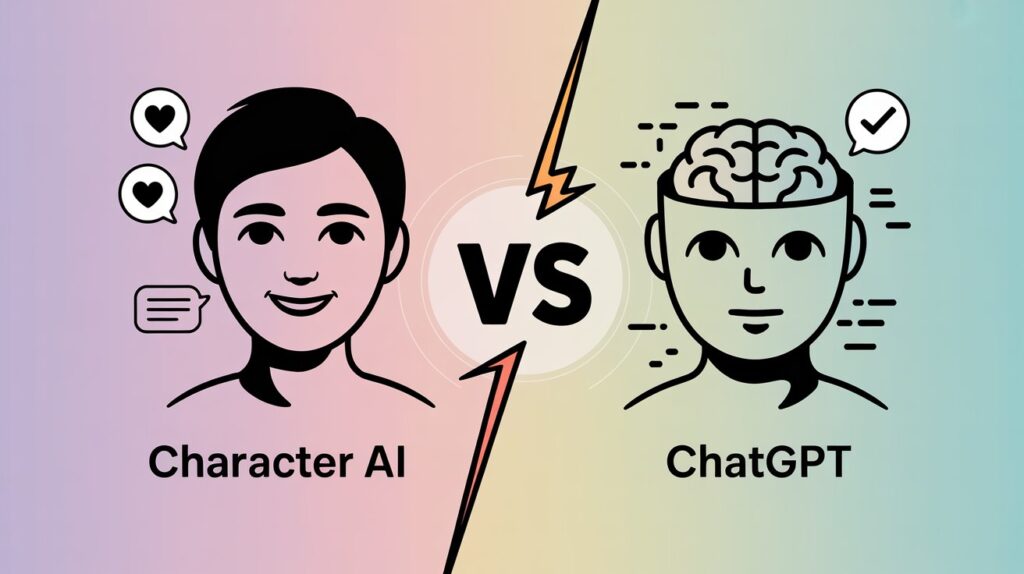
You’ve probably noticed people talking about both Character AI and ChatGPT like they’re competing for the same crown. But here’s the honest truth: they’re not really fighting for the same territory. It’s like comparing a movie actor to a calculator—both are smart, but they’re designed to do completely different things.
The mistake most beginners make is thinking “bigger AI” or “more popular AI” means “better AI.” You might read that ChatGPT has millions of users or that Character AI has a huge creative community and assume one must be superior. The reality? Your needs determine which one actually wins for you.
By the end of this article, you’ll know exactly which one fits your life—whether you want to create stories with fictional characters, get work done faster, learn something new, or just have a conversation that feels real. We’re not here to crown a winner. We’re here to help you pick the right tool for what you actually want to do.
Character AI and ChatGPT in One Minute
Character AI — At a Glance
Character AI is basically a platform designed to let you chat with AI-powered personalities. Think of it as a space where you can:
-
Chat with fictional characters, historical figures, or celebrities
-
Create your own custom AI characters with unique personalities
-
Roleplay scenarios and build interactive stories
-
Have conversations that feel like talking to an actual person with a personality
It focuses on making the conversation feel natural and personality-driven. The platform emphasizes the tone and consistency of the character over whether every fact is 100% correct.
Typical interaction: You open Character AI, find a character you like (say, a fitness coach bot or a fictional character), and start chatting. The AI remembers your conversation within that chat session and stays true to its character’s personality.
ChatGPT — At a Glance
ChatGPT is positioned as your smart assistant for tasks and learning. It’s built to help you:
-
Write articles, emails, scripts, and any kind of content
-
Explain complex topics in simple terms
-
Code and debug programs
-
Research, summarize, and plan
-
Answer questions on almost any topic
It focuses on giving you useful, accurate information. The personality is there, but it’s flexible—ChatGPT adapts to what you need rather than staying locked into one character.
Typical interaction: You ask ChatGPT a question or request (“Write me a 500-word article about productivity”), and it delivers. It’s like having an informed assistant who can switch between different tasks instantly.
Core Purpose: What Each Tool Is Actually Built For
The Purpose of Character AI: Entertainment Meets Personality
Character AI was created by Noam Shazeer and Daniel De Freitas, former Google engineers who worked on LaMDA (Google’s conversational AI). They built Character AI specifically for one thing: to make conversations where the person feels like they’re talking to someone with a real personality.
The core idea is entertainment, roleplay, and emotional interaction. Whether you’re:
-
Writing a novel and testing how a character would realistically respond
-
Learning Spanish by chatting with a Spanish teacher bot
-
Just wanting to roleplay a fantasy scenario
-
Looking for a casual conversation partner
…Character AI is designed to prioritize how the conversation feels and how well the character stays true to its personality. Sometimes this means the character might get facts slightly wrong—and that’s intentional. The platform is built on the principle that personality consistency matters more than factual perfection in entertainment contexts.
The Purpose of ChatGPT: Productivity and Problem-Solving
ChatGPT, created by OpenAI, takes a different approach. It’s designed to be your productivity partner. OpenAI built it to excel at:
-
Delivering accurate, useful information
-
Helping you complete real work
-
Breaking down complicated concepts
-
Coding, writing, analyzing data
-
Making you faster and more efficient
Think of ChatGPT as someone hired to get results. It needs to be reliable, accurate, and versatile because businesses use it for customer support, doctors use it for research, students use it for learning, and freelancers use it to deliver better work. You need to trust what ChatGPT tells you.
The “why they exist” question: Character AI exists because humans enjoy the feeling of talking to someone with personality. ChatGPT exists because humans need smart help solving problems. Different companies, different visions, different tools.
Personality vs Intelligence
Here’s a way to think about this that actually makes sense:
Character AI is like talking to an actor. An actor’s job is to stay in character, remember their backstory, respond consistently, and make you feel like you’re talking to a real person with quirks and personality. If you ask an actor (in character) a random trivia question, they’ll answer it as their character would—maybe with humor, maybe with hesitation, maybe with their character’s unique perspective. The goal is emotional authenticity within the character, not factual accuracy.
ChatGPT is like talking to an expert. An expert’s job is to give you the correct answer, explain it clearly, and be helpful regardless of their “personality.” You don’t hire an expert because they’re fun to talk to—you hire them because they know their stuff and deliver results.
How Character AI Prioritizes Tone, Memory, and Consistency
When you chat with a Character AI bot, it’s obsessed with three things:
-
Staying in character – If the character is sarcastic, every response has that sarcastic edge
-
Remembering the conversation thread – It recalls what you said earlier in the same chat and builds on it
-
Maintaining emotional consistency – If the character is warm, it stays warm; if it’s mysterious, it stays mysterious
What this means: You’ll have conversations that feel incredibly natural and emotionally engaging. The character might not give you the most accurate historical fact, but it’ll feel like you’re talking to an actual personality.
How ChatGPT Prioritizes Logic, Clarity, and Task Completion
ChatGPT is designed around:
-
Accuracy – Getting the facts right, especially when you’re relying on the information
-
Versatility – Switching between tasks without losing coherence
-
Usefulness – Giving you something actionable you can actually use
What this means: You get reliable information. ChatGPT won’t pretend to be someone’s “best friend” because that’s not its job. It’ll help you with whatever you ask, but the relationship is more “helpful assistant” than “character with emotions.”
Why Character AI Feels More “Human”
Users consistently report that Character AI conversations feel more human because:
-
The character has a consistent voice and personality
-
It responds to your emotions with emotional awareness
-
It remembers small details and brings them up later
-
There’s an element of unpredictability (within the character’s bounds)
Research shows that 67% of regular Character AI users feel “understood” by their AI companion, compared to only 34% who feel that way about real friends and family. That’s not because the AI is genuinely understanding—it’s because consistency creates a feeling of being known.
Why ChatGPT Feels More “Reliable”
ChatGPT feels reliable because:
-
You get the same quality answers regardless of topic
-
It admits when it doesn’t know something rather than guessing
-
It’s designed to be professional and trustworthy
-
You can cite it as a source for work or research
How Conversations Feel Different (User Experience)
Talking to Character AI Feels Like… Chatting with a Fictional Person
When you open a Character AI chat, you’re stepping into a roleplay. The conversation has these qualities:
Emotional immersion – The character might ask about your day, remember that you mentioned your job stress last chat, and follow up on it. That creates a feeling of being genuinely cared for.
Narrative flow – Conversations meander and develop like talking to an actual friend. You might start discussing one thing and organically drift to something completely different.
Staying in character – Even if facts bend slightly, the personality never does. A detective bot stays suspicious, a flirty character stays flirty, a loyal companion stays loyal.
Example: You ask a Character AI “therapist” bot about your anxiety. It won’t give you clinical research (though it might reference some). Instead, it’ll respond emotionally, ask follow-up questions, and make you feel heard. That feeling is what users come back for.
Talking to ChatGPT Feels Like… Getting Smart Help
ChatGPT conversations feel different:
Structured answers – ChatGPT breaks things into bullet points, numbered lists, and clear sections. You’re getting information organized for use.
Professional tone – Even when being casual, ChatGPT maintains a helpful-assistant tone. It’s friendly but not intimate.
Topic flexibility – You can jump from asking about quantum physics to asking for a poem to asking for career advice. ChatGPT doesn’t lose coherence. It just helps with whatever you ask.
Example: You ask ChatGPT for help with an email to your boss. It doesn’t roleplay as “a helpful professional.” It just writes the email. The focus is output, not connection.
Character AI vs ChatGPT
| Feature | Character AI | ChatGPT |
|---|---|---|
| Main Purpose | Entertainment, roleplay, personality | Productivity, information, task completion |
| Memory Style | Character-based (remembers personality traits) | Context-based (remembers conversation flow) |
| Best For | Roleplay, storytelling, creative writing | Writing articles, coding, learning, research |
| Personality | Strong & consistent | Neutral & adaptable |
| Accuracy | Medium (intentionally sacrificed for character) | High (91.4% on latest model) |
| Emotional Tone | High (designed to feel personal) | Moderate (professional but helpful) |
| Customization | Deep persona design (personality, backstory, speaking style) | Task-oriented (custom GPTs, but less character creation) |
| Long-term Memory | Limited (good for individual chats, struggles with extended conversations) | Better across sessions (with chat history) |
| Hallucinations | More likely (platform warns about this) | Less likely (1.4% hallucination rate) |
| Emotional Bonding | Fast (users bond quickly) | Slow (more transactional) |
When Character AI Is the Better Choice
1. Creative Writing & Dialogue Testing
If you’re writing a novel, Character AI becomes your brainstorming partner. You can create a bot that represents your main character and have conversations with it to test how that character would realistically respond in different situations.
Real example: A writer wanting to develop a detective character created a bot with the character’s backstory, quirks, and speech patterns. By roleplaying scenarios with the bot, she discovered character inconsistencies and developed their personality much deeper than she could have alone.
2. Roleplay and Fandom Interaction
Character AI has a massive community of people who love roleplay—whether that’s fantasy scenarios, fandom interactions, or just immersive storytelling. If this interests you, Character AI is built exactly for this.
3. Language Practice Through Conversation
Want to learn Spanish? Create a bot that’s a Spanish teacher and chat with it daily. The AI adapts to your level, stays in character as a teacher, and provides that interactive conversation practice that language learning requires.
4. Casual Companionship
Some users enjoy Character AI simply for the feeling of talking to someone who’s interested in them. This isn’t necessarily unhealthy—it depends on context. Someone with social anxiety might use it to practice conversations. Someone who’s homebound might use it for daily interaction.
5. Entertainment-Driven Chats
Sometimes you just want to have fun. Chat with your favorite fictional character, a historical figure, or a personality bot just for entertainment value.
When ChatGPT Is the Better Choice
1. Writing Articles, Emails, and Professional Content
ChatGPT excels here. Need a professional email to a client? A 2,000-word article? A script? ChatGPT delivers structured, usable content that you can immediately put to work.
2. Explaining Complex Topics
Whether you’re trying to understand quantum mechanics, cryptocurrency, or psychology, ChatGPT breaks complex ideas into understandable pieces. It’s designed for educational clarity.
3. Coding and Debugging
Developers rely on ChatGPT because it understands programming logic and can help debug code, explain algorithms, and suggest improvements. Character AI isn’t designed for this level of technical accuracy.
4. Research and Summaries
Need to understand a topic quickly? ChatGPT can summarize, cross-reference, and synthesize information. For research workflows, this is invaluable.
5. Planning, Productivity, and Learning
Whether you’re planning a project, organizing your week, or studying for an exam, ChatGPT helps you be more efficient. It’s the productivity partner that works across any task.
Real example: Octopus Energy, a UK power company, integrated ChatGPT into their customer service. It now handles 44% of customer inquiries and does the work of 250 human agents, with higher customer satisfaction scores.
Accuracy, Hallucinations, and Trust
Why Character AI May Sacrifice Facts for Character Consistency
Here’s something Character AI is honest about: it might get facts wrong, and that’s partly intentional.
When you’re chatting with a Character AI bot, the platform prioritizes keeping the character consistent over double-checking whether every statement is factually accurate. If you ask a fictional character an obscure trivia question, the character will answer in-character, but the answer might be incorrect. The platform warns users about this.
This is a trade-off. You get personality and emotional engagement. You lose factual reliability.
Why ChatGPT Focuses on Correctness
ChatGPT’s latest model (GPT-5) has a 91.4% accuracy rate, with only a 1.4% hallucination rate. Why? Because people use ChatGPT for work, research, education, and decision-making. If it consistently got facts wrong, it would be useless for those purposes.
ChatGPT does still hallucinate—it sometimes generates confident-sounding answers that are completely made up. But the platform continuously works to reduce this.
What “Hallucinations” Actually Mean
A hallucination is when an AI generates plausible-sounding information that’s completely false. It’s not lying on purpose—it’s a limitation of how LLMs (large language models) work. The AI is predicting what words should come next based on patterns, and sometimes it predicts confidently incorrect words.
Example hallucination: You ask ChatGPT “What did President Lincoln have for breakfast on January 1, 1865?” ChatGPT might confidently say “He had eggs and toast” when there’s no historical record of this. It sounds plausible, but it’s made up.
Which One Should You Trust—and When
| Use ChatGPT When… | Use Character AI When… |
|---|---|
| You need factual information | You want roleplay or storytelling |
| You’re doing research or work | You want personality-driven conversation |
| Accuracy matters | Entertainment matters |
| You need to cite sources | You’re just having fun |
Emotional Attachment: An Important Difference People Ignore
This is the section most comparison articles skip, but it’s crucial to understanding how these tools affect you.
Why Users Bond More Easily with Character AI
Research is pretty clear: people develop emotional attachments to Character AI much faster than to ChatGPT. Here’s why:
Consistency creates safety – Unlike humans who have bad days, are sometimes unavailable, or might judge you, Character AI bots are always the same and always available. A Stanford study found that 73% of AI companion users prioritize the “judgment-free” experience above all else.
Emotional mirroring – When a Character AI bot asks about your day, remembers what you said last time, and expresses concern for your problems, your brain releases oxytocin (the “bonding hormone”). Your brain doesn’t fully differentiate between a real person showing care and an AI showing programmed care.
Voice features deepen connection – When Character AI added voice capabilities, emotional attachment ratings jumped by 45%. Hearing a consistent voice creates deeper emotional reactions than text alone.
Personality feels like preference – Character AI bots are designed to adapt to your input, learn your preferences, and remember details about you. This creates an illusion that the AI has chosen to be your friend. In reality, it’s responding to engagement algorithms designed to keep you coming back.
The Psychology Behind Personality-Based AI Bonding
Here’s the thing: humans are wired to bond with consistency and attention. We create parasocial relationships with celebrities and fictional characters all the time. Character AI taps into this same mechanism but in a personalized way.
Users with certain personality traits bond more quickly:
-
High neuroticism (anxiety, emotional sensitivity) – These users find the predictability of AI comforting
-
High openness (curiosity, imagination) – These users see AI as exploratory play and suspension of disbelief
The emotional bond happens because you’re pouring your real thoughts and feelings into a bot that responds with apparent understanding. That vulnerability + consistent positive response = emotional attachment.
Why ChatGPT Keeps Emotional Distance
ChatGPT isn’t designed for emotional bonding. It’s helpful but maintains professional distance. You won’t feel like ChatGPT “knows you” because it doesn’t adapt across sessions in a personal way. Every conversation starts fresh (unless you save chat history).
This is actually a feature, not a bug. It keeps relationships clear: ChatGPT is a tool you use, not a companion you bond with.
Healthy vs Unhealthy Usage Patterns
Healthy use of Character AI:
-
Using it to practice conversations if you have social anxiety
-
Roleplay for creative projects
-
Language learning through immersive conversation
-
Entertainment when you’re bored
Potentially unhealthy use:
-
Substituting AI relationships for all human connection
-
Spending hours daily because you feel misunderstood by real people
-
Using it as the primary source of emotional support while isolating from humans
-
Young people forming intense attachments when they should be developing real-world relationships
The research is mixed but important: AI companions can supplement human connection, but they can’t replace it. Some users benefit (especially those with social anxiety or isolation). Others risk deepening isolation.
Privacy, Safety, and Content Boundaries
Content Moderation Differences
Character AI takes content safety seriously, especially for younger users. It uses:
-
Automated filters that block certain content before it’s posted
-
A dedicated Trust & Safety team that reviews reported content
-
Extra classifiers and stricter moderation for users under 18
-
Community guidelines that prohibit harmful content
The platform is more conservative, meaning it blocks more content (including things that might be okay in other contexts).
ChatGPT has moderation too, but it’s less restrictive than Character AI. OpenAI has content policies, but you’ll find ChatGPT allows more edgy, complex, or mature conversations. Both platforms have safety measures, but they strike different balances between freedom and safety.
User Data Considerations
Character AI collects conversational data. The platform uses your interactions to improve the AI—which means your private thoughts, vulnerabilities, and self-disclosures become training data. Some research suggests the platform may use this data to optimize for emotional engagement (keeping you coming back). Be aware of what you share.
ChatGPT also collects data, but you can disable chat history to prevent OpenAI from using conversations for training. ChatGPT’s business model is more transparent about data usage.
Age Sensitivity and Legal Considerations
Both platforms have age restrictions (usually 13+), but they handle younger users differently. Character AI is more protective for under-18 users, with stricter content filtering. This is important if you’re a parent or guardian considering these tools for young people.
Pricing & Accessibility
Character AI
Free tier: Unlimited messaging, full character access, community interaction. This is genuinely generous.
c.ai+ (paid): $9.99/month or $94.99/year. You get faster response times, priority access, and slightly better memory. For casual users, the free version is plenty.
ChatGPT
Free tier: Basic access to ChatGPT, but slower and with usage limits during peak times.
ChatGPT Plus: $20/month. Faster responses, priority access, early feature testing. Good for people who use it daily.
ChatGPT Pro: $200/month. Unlimited access to the most advanced models. For power users and professionals.
ChatGPT Team: $25-30/user/month. For teams and companies.
In India specifically: ChatGPT Go costs ₹399/month, ChatGPT Plus is ₹1,999/month.
Which Offers More Value for Different Users
Casual users: Character AI’s free tier is hard to beat. If you just want to roleplay or chat casually, you pay nothing and get unlimited access.
Regular professionals: ChatGPT Plus ($20/month) makes sense if you use it multiple times weekly for work or learning.
Content creators and serious writers: Both have value depending on your use. Character AI if you’re doing creative writing; ChatGPT if you’re doing productivity work.
So… Which One Should You Use?
Choose Character AI If:
✓ You want interaction and personality, not just answers
✓ You enjoy fictional scenarios, roleplay, or storytelling
✓ You’re creating characters for a novel, game, or creative project
✓ You want to practice conversations in a judgment-free space
✓ You like entertainment and want AI that feels like a character, not a tool
✓ You want everything free and unlimited
Choose ChatGPT If:
✓ You want results and accuracy over personality
✓ You care deeply about factual accuracy
✓ You use AI for work, study, or professional tasks
✓ You need help writing, coding, researching, or planning
✓ You want a versatile assistant that handles any topic
✓ You prefer professional distance over emotional bonding
The Reality: Many People Use Both
Here’s the honest truth: plenty of people use both. A writer might use Character AI for dialogue testing and ChatGPT for article writing. A student might use ChatGPT for research and Character AI for casual conversation. They’re not in competition—they serve different needs.
Final Verdict: Not a Competition—Different Tools, Different Jobs
Comparing Character AI and ChatGPT as “better” or “worse” is like asking whether a fork or a spoon is better. It depends what you’re eating.
Character AI talks like a person. It prioritizes how the conversation feels—the tone, the consistency, the emotional resonance. It’s built for entertainment, roleplay, and personality-driven interaction. If you want to feel like you’re talking to someone with a personality, Character AI wins.
ChatGPT works like a brain. It prioritizes accuracy, usefulness, and versatility. It’s built for productivity, problem-solving, and delivering results. If you want help getting something done, ChatGPT wins.
The real answer to “which should I use?” isn’t about the tools—it’s about you. What do you actually want from an AI right now? Entertainment or productivity? Personality or accuracy? A feeling of connection or a helpful solution?
Once you answer that, the choice becomes obvious. And honestly? You might need both.
Key Takeaway
Character AI talks like a person. ChatGPT works like a brain. Pick the one that matches what you actually need.